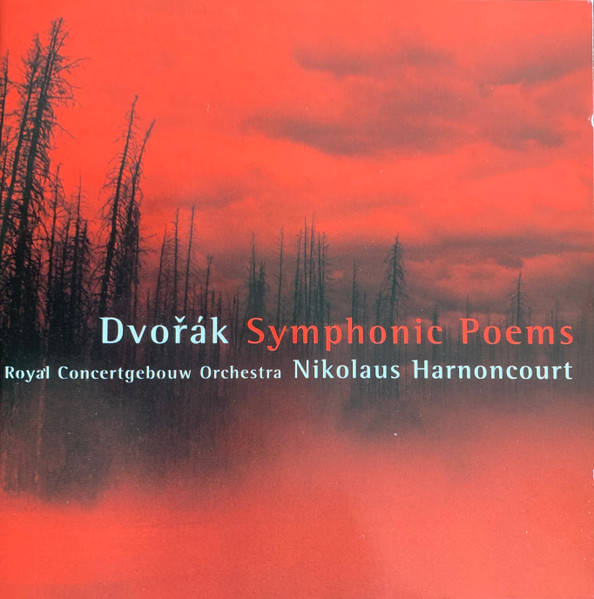
 |
|
1
CD | 2564-60221-2 | ℗ &
© 2003
|
|
| Antonín Dvořák
(1841-1904) |
|
|
|
|
|
|
|
The
Golden Spinning Wheel (Zlatý kolovrat),
Op. 109
|
|
28'
21" |
CD 1 - 1
|
The Noon Witch
(Polednice), Op. 108
|
|
13' 47" |
|
- Allegretto
|
5' 44" |
|
CD1 - 2
|
| - Largo |
3' 18" |
|
CD1 - 3
|
| - Scherzo: Molto
vivace |
2' 07" |
|
CD1 - 4
|
| - Allegro con fuoco |
2' 38" |
|
CD1- 5
|
| The Water Goblin
(Vodník), Op. 107 |
|
21' 08" |
CD2 - 1
|
| The
Wild Dove (Holoubek), Op. 110 |
|
19'
45" |
CD2 - 2 |
|
|
|
|
| Royal
Concertgebouw Orchestra |
|
| Nikolaus
Harnoncourt |
|
|
Recording
|
| Het Concertgebouw,
Amsterdam (Olanda): 24-26 October 2001 (Op.
109; December 1998 (Op. 108); October 1999
(Op. 107); December 1997 (Op. 110) | live
(Opp. 108 & 109) | studio (Opp. 107
& 110) | Friedemann Engelbrecht | Helmut
Mühle | Michael Brammann | Tobias Lehmann |
Philipp Knop | René Möller | Peter
Weinsheimer | Jörg Mohr | Jens Schünemann |
First edition on CD
|
| Warner Classics - Teldec |
2564-60221-2 | 2 CDs | 42' 43" & 41' 03"
| DDD | LC 6019 | ℗ & © 2003 |
| Note |
This publication homogeneously
collects the four Symphonic Poems Opp.
107-110 already published separately.
|
|
|
Notes
|
In the late 19th
century, many composers began
setting to music non-musical
topics that were often
inspired by literature. The
symphonic poem, as this young
genre was called, became the
domain of the “New German
School" centered around Liszt,
Wagner and Strauss, and was
bitterly criticised by the
supporters of Brahms, who, as
the champion of a classical
aesthetic of absolute music,
represented the opposite pole.
With his symphonic poems Opp.
107-110, Antonin Dvořák
(1841-1904) thus set out to
cross an ideological
minefield. Although he had
been welcomed into the
“Brahmsian" camp with his
symphonic and chamber-music
works, he left their puristic
tenets behind him in his later
oeuvre. Dvořák
wrote his four symphonic poems
in 1896, upon his return from
America. He thus switched over
to “the faction of the
reflective programmatic
composers", to use the words
of a reviewer. It should be
noted, however, that Dvořák‘s
heightened interest in the
symphonic poem and, by
extension, program music was
not as sudden as it might
seem, since his last symphony,
From the New World, had
already contained an implicit
program.
According to Liszt's
definition of the genre, the
symphonic poem is
characterised by the fact that
“while they should not be
neglected, all exclusively
musical considerations are to
be subordinated to those of
the action of the given
subject." Dvořák
followed this premise by
giving absolute priority to
his literary sources while
continuing to cast his
symphonic poems in
conventional forms (The
Water Goblin is
conceived as a rondo; The
Noon Witch conceals a
symphonic form). Dvořák
always sought to “bring out
the various main figures,
their characters and the
poetic atmospherc", to quote
the composer. In his character
sketches, he kept so close to
the text that one could
effortlessly underlay the
poem’s respective verses. The
poems on which the pieces are
based were all taken from
Jaromir Erben's collection Kytice,
which had long since seized
the composer’s attention; it
had supplied the text to The
Specter's Bride, for
example. Perhaps Dvořák
found the definitive stimulus
to return to these folk
ballads on the occasion of the
25th anniversary of Erben‘s
death on 21 November 1895.
The stories were remarkably
blood-curdling affairs for a
father of nine to take as his
models. In The Noon Witch,
an overwrought mother
threatens hcr whining child
with the noon witch, who then
kills the child, and in The
Water Goblin a newborn
infant also perishes. The
gruesome subjects created
ripples of unease among the
sensitive urban public, and
the Viennese music critic
Eduard Hanslick noted: “I can
hardly imagine how someone
would choose to make a musical
depiction of such a revolting
topic, a story that shocks
every discriminating person."
All the more discriminating,
however, is the composer in
his musical treatment of the
topics. This applies in
particular to The Water
Goblin Op. 107. In his
biography of the composer,
Jaromil Burghauser underscores
the “colourfulness of the
expressive means, so close to
Impressionism." Dvořák
gives the water goblin’s
sub-aquatic world a charm that
is nothing less than magical
and sensual. The muted strings
create a glittering sound
surface that inevitably
reminds one of the French
impressionists‘ evocations of
the sea. When the piece
begins, we see the water
goblin sitting on the bank of
a lake. This is followed by a
dialogue between a mother and
her daughter. In spite of her
mother's warnings, the
daughter goes too close to the
lake and is abducted by the
water goblin, who takes her as
his wife. After the birth of a
child, he lets her return home
briefly, but keeps the child
as a hostage. When she does
not return before the evening
bells peal, the spirit kills
the child and hurls its
battered body at the women‘s
hut.
In The Noon Witch Op.
108, the composer treated his
source more freely and
prefaced the actual narration
by describing an idyllic
setting. The peace is then
disturbed by the child's
piercing screams (the oboe’s
repeated notes), which prompts
the mother to utter her
above-mcntioned threat. A slow
movement with evocative string
chords in pianissimo suggests
the heavy, oppressive
atmosphere marking the
approach of the noon witch who
demands that the child be
handed over to her. A frantic
struggle for the child ensues
(Scherzo), after which the
bells peal twelve times and
the nightmare seems to be
over. In the final episode,
the father returns home and
discovers that his wife has
suffocated the child in her
panicstricken embrace.
In the latter two symphonic
poems, the nature spirits are
advocates of positive forces.
The Golden Spinning Wheel
Op. 109 is a kind of Czech
variation of the Cinderella
topic. Opening the piece is a
horn fanfare signalising that
the king has organised a
hunting party. In the woods,
he meets the peasant girl
Dornicka and falls in love
with her. While she is on her
way to the palace, she is
killed and gruesomely
mutilated by her stepmother
and stepsister. The
unsuspecting king then marries
the wrong woman. A wizard
finds the mutilated body in
the woods and sends his
apprentice to the palace with
a golden spinning wheel. He
offers the wheel to the young
queen in exchange for
Dornicka’s eyes, arms and
legs. After Dornicka is pieced
together again, she returns to
life to the strains of a
delicate violin cantilena,
whereby Dvořák
gives an incantatory, ritual
feeling to the old man’s
magical words through
church-musical turns. The
golden spinning wheel thus
reveals the crime to the king,
who rides into the woods and
brings Dornicka home. The
composer discreetly glosses
over the ghastly end of the
two evil women in order to let
the piece end on a note of
undisturbed happiness.
There is more barbarity in the
last symphonic poem as well, The
Wild Dove Op. 110. The
scene begins with a muted
Funeral procession. The young
widow’s tears are not genuine,
however, for she has poisoned
her husband in order to marry
her lover. Their wedding is
followed by merry dancing. Dvořák
sets measures in duple and
triple time against each
other, as if the excessive
boisterousness of the dancing
were intended to numb the
widow's guilty conscience.
Over the grave of the murdered
husband sits a wild dove,
whose cooing keeps reminding
the woman of her deed and
finally drives her into the
water, where she drowns. As he
had done in The Golden
Spinning Wheel, Dvořák
also lets this piece come to a
conciliatory end: the spectral
string chords of the epilogue
testify to the transfiguration
of the repentant sinner.
Gunilla
Eschenbach
Translation:
Roger Clement
|
|
Nikolaus
Harnoncourt (1929-2016)
|

|

|
|