 |
2 LP - 6.35350 EX - ℗ 1976
|
 |
| 1 LP -
SAWT 9565-B - ℗
1970 |
 |
| 1 CD -
8.41124 ZK - © 1986 |
 |
| 1 LP -
SAWT 9536-A - ℗
1969 |
 |
| 1 CD -
8.43772 ZS - © 1987 |
|
| Johann Sebastian
Bach (1685-1750) |
|
|
|
|
|
|
|
| Kammermusik - Vol. 3 |
|
|
|
|
|
|
|
Ein Musicalisches
Opfer, BWV 1079
|
|
46' 26" |
A/B |
| Canon perpetuus super
thema regium (Querflöte, Violine,
Tenorviola) | Canon a 2 (Cembalo)
| Canon a 2 Violini in unisono (2
Violinen, Cembalo, Violoncello) |
Canon a 2 Per motum contrarium (Querflöte,
Violine, Viola) | Canon a 2 Per
augmentationem, contrario motu (2
Violinen, Tenorviola) | Canon a 2
Per tonos (Violine, Viola, Tenoreviola)
| Fuga Canonica in Epidiapente (Querflöte,
Violine, Cembalo, Violoncello) |
Ricercare a 6 (Cembalo) | Canon a 2
(Cembalo) | Canon a 4 (Querflöte,
2 Violinen, Cembalo, Violoncello) |
Trio: Largo. Allegro. Andante. Allegro (Querflöte,
Violine, Cembalo, Violoncello) |
Canon perpetuus (Querflöte, Violine,
Cembalo, Violoncello) |
|
|
|
|
|
|
|
| Sonate G-dur für Viola
da gamba und Cembalo, BWV 1027 |
|
11' 42" |
C1 |
| - Adagio · Allegro ma
non tanto · Andante · Allegro moderato |
|
|
|
Sonate D-dur für Viola
da gamba und Cembalo, BWV 1028
|
|
13' 08" |
C2 |
- Adagio · Allegro ·
Andante · Allegro
|
|
|
|
Sonate g-moll Viola da
gamba und Cembalo, BWV 1029
|
|
13' 52" |
D1 |
| - Vivace · Adagio ·
Allegro |
|
|
|
Sonate C-dur
(Triosonate) für 2 Violinen und Basso
continuo, BWV 1037
|
|
12' 18" |
D2 |
- Adagio · Alla breve
· Largo · Gigue. Presto
|
|
|
|
|
|
|
|
Herbert Tachezi,
Cembalo (R. Schütze, Heidelberg,
in niederländischer Bauweise;
Martin Skowroneck, Bremen, nach
einem italienischen Instrument um
1720)
|
| Leopold Stastny,
Querflöte (A. Grenser, Dresden,
um 1750) |
| Alice
Harnoncourt, Walter Pfeiffer,
Violinen (Jacobus Stainer, Absam
1665; Matthias Albanus, Bozen
1712) |
Kurt Theiner,
Viola (Marcellus Hollmayr, Wien
um 1650)
|
| Nikolaus
Harnoncourt, Tenorviola
(Tirol um 1650); Viola da gamba
(Jacobus Stainer, Absam 1667);
Violoncello (Andrea Castagneri,
Paris 1744) |
|
Luogo
e data di registrazione
|
Casino
Zögernitz, Vienna (Austria) - febbraio /
marzo 1970 | BWV 1079
Vienna (Austria) - marzo e aprile 1968 |
Sonaten BWV 1027-1029
Unknown | BWV 1037
|
|
Registrazione
live / studio
|
| studio |
Producer
/ Engineer
|
-
|
Prima Edizione CD
|
Teldec "Das Alte Werk" |
8.41124 ZK | 1 CD | ADD | 46' 40" | ©
1986 | BWV 1079
Teldec "reference" | 8.43772 ZS
| 1 CD | 42' 17" | © 1987 | BWV
1027-1029 |
|
Prima
Edizione LP
|
Telefunken -
Kammermusik vol. 3 | 6.35350 EX | 2 LPs |
46' 26" & 51' 17" |
℗ 1976 | BWV 1037
Telefunken
- Das Alte Werk | SAWT 9565-B | 1 LP | 46'
40" | ℗ 1970 | BWV 1079
Telefunken - Das Alte Werk
| SAWT 9536-A | 1 LP | 42' 17" | ℗ 1969 | BWV
1027-1029 |
|
Note
|
| La
Sonate C-dur (Triosonate) BWV 1037 non è
stata, ad oggi, riversata in Compact
Disc. |
|
|
Notes on the
performance
|
The
origins of “The Musical
Offering” are closely
connected with Bach’s
memorable visit to the court
of Frederick II of Prussia
in Potsdam. This event is
one of the few outstanding
highlights of Bach’s
biography, which is not
exactly rich in spectacular
happenings. Undoubtedly it
was also the culminating
point of Bach’s public
recognition when several
North German newspapers
published an identical
detailed report on the
Thomas cantor’s meeting with
the king on 7th May, 1747:
“In the evening, at about
the time when chamber music
was usually want to be
played in the royal
apartments, His Majesty was
informed that Kapellmeister
Bach had arrived in Potsdam
and was now waiting in the
ante-chamber for gracious
permission to be allowed to
listen to the music. His
Majesty personally gave
immediate orders for him to
be admitted, and when he had
entered, crossed to the
so-called Forte and Piano
and without any preparation
condescended to play a theme
to the Kapellmeister which
the latter was to play in
extemporised fugal form.
This was performed by the
aforementioned Kapellmeister
in such a wonderful manner
that not only His Majesty
was gracious enough to
express his pleasure, but
also all the others present
were amazed. Herr Bach
considered the theme set to
him such a paragon of beauty
that he intends to write it
as a proper fugue and
afterwards to have it
engraved in copperplate.”
The newspaper report
describes here in terse, but
impressively descriptive
phrases the beginning of the
history of Bach’s last
chamber music work in a
manner which has never
remotely been achieved with
regard to his other
compositions. The nucleus is
formed by the theme drafted
by the king, which as a
combination of two
traditional soggetto models
was consciously chosen as a
difficult piece and was
assuredly taken up by Bach
without any substantial
change. To be sure, the
“Thema regium” in its
musical diction bears the
unmistakable Bach hallmark.
It is not hard to imagine
how the theme provided by
the king might have sounded
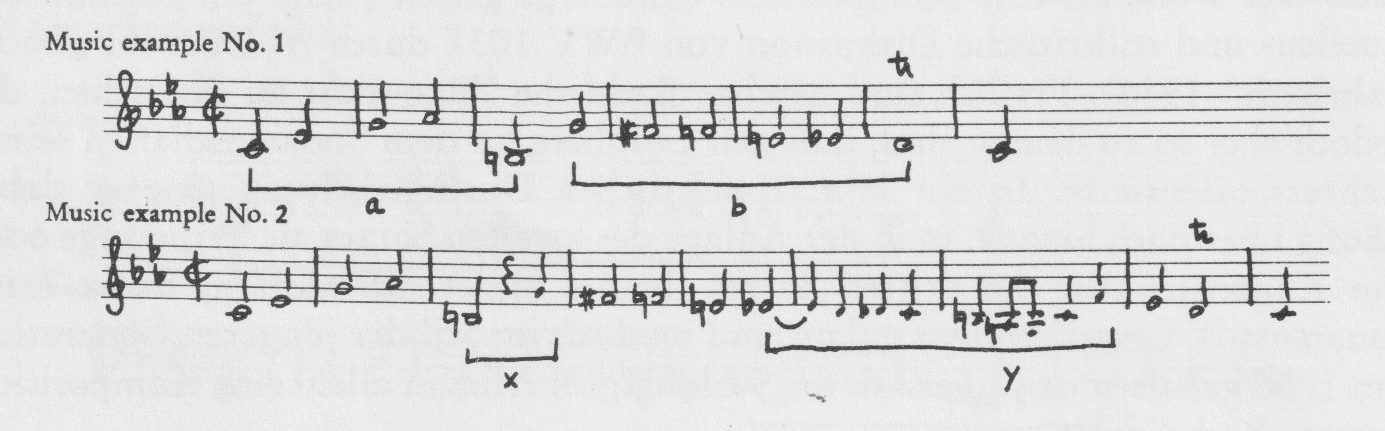
in its original form: Music
example No. 1. The ascending
minor triad with descending
diminished seventh chord
leap (a) as well as the
chromatic tetrachord (b) are
not original inventions, but
were common musical
knowledge since the 17th
century. The king was
therefore able without any
preparation to revert to
this material, with which he
must have been acquainted.
The organic assembly of the
two heterogeneous elements,
however, was probably Bach’s
idea, whereby the joining
seam between the two
soggetti is rhythmically
rearranged (x) and by the
extended insertion (y) of
the thematic conclusion
takes on dynamic contours
(music example No. 2). To
what specific extent Bach
edited the theme, however,
is beyond speculation,
although it is worth
considering what actually
lends the “Thema regium”
Bachian significance and
flavour.
This theme, considered such
a “paragon of beauty”, saw
its first development in the
improvised fugue as it
probably existed in the
ternary form ricercar in the
subsequently elaborated
shape; traces of the free
paraphrasing between the
less concentrated exposition
parts of the fugue movement
can still be clearly seen
from the ricercar.
Immediately following the
Potsdam improvisation Bach
will also have conceived the
plan of submitting at least
this fugue in print. The
expanded project in the
sense of a several-part
monothematic instrumental
work must have taken on firm
outlines afier Bach’s return
from the journey. The
Potsdam events still have a
lasting effect in the wider
concept of the work; for the
six-part ricercar is nothing
else but the subsequently
delivered “fugue with six
obbligato parts” requested
by the king at that time,
the improvision of which
Bach (according to the
report of the obituary
writer in 1754) felt capable
of approaching only with a
self-chosen theme. The trio
sonata is understood as a
special gift to the
flute-playing monarch to
enrich his chamber music
repertoire. The ten canons
are exemplary samples of
Bach’s contrapuntal
craftmanship which had
apparently called forth the
king’s admiration. Bach
completed the entire opus in
a comparatively short time,
for as early as the end of
September, 1774 he was in a
position to insert a
publisher’s advertisement in
the newspapers: “Since the
... promised Royal Prussian
fugue theme is now being
printed; it is hereby
announced that it can be
obtained at the impending
St. Michaels fair as well as
from the author,
Kapellmeister Bach, as well
as from his two sons in
Halle and Berlin... The
elaboration consists 1.) of
two fugues, one with 3 the
other with 6 obligato parts;
2.) of a sonata, à traversa,
violin e continuo; 3.) in
various canons, one being a
canonic fugue.”
The complete work therefore
comprises various solo and
ensemble pieces, with each
individual setting based
upon the “Thema regium.” It
was Bach’s aim to treat this
theme in the most varied
manner, from the free
setting to the strictest
contrapuntal entity without
regard to a unified tonal
medium. This diversity is
also reflected in the
external appearance of the
original printing in 1747,
made up of three fascicles
and consisting of single
pages and sheets, presenting
the musical contents in
varying notation styles:
piano notation (ricercar a
3), open score (ricercar a
6), additional parts
(sonata) and encoded mystery
notations (canons). Bach
evidently did not place any
importance upon an overall
order or binding movement
sequence, since he did not
intend to conceive the work
as a cyclic grand form.
Modern performances of the
collection therefore have to
find their own solutions.
As can be assumed from the
advertisement previously
referred to, three groups of
arrangements of the “Thema
regium” can be
distinguished.
(1) The two fugues:
these are called “ricercar”
(an exception in Bach’s
fugal works) because the
term, which had a double
meaning in the 18th century,
effectively characterises
the difference in the two
pieces. According to the
definition in J. G. Walther’s
“Musicalisches Lexicon”
(Leipzig, 1732), a
distinction has to be made
between an improvisational
type of ricercar (wherein it
appears as if the composer
were seeking the harmonious
passages or drafts”) and a
processed type of fugue
(“artistically composed
after strong reflection”).
Bach produces this stylistic
contrast in the two fugues.
Furthermore, with an
ingenious acrostic he
dedicates the ricercar a 6
in the third fascicle of the
original printing: “Regis
Iussu Cantio
Et Reliqua Canonica
Arte Resoluta”,
which means “Upon the King’s
Demand, the Theme and
Additions Resolved in
Canonic Style.”
(2) The four-movement
“Sonata sopr’ il Soggetto
Reale”: In formal
scheme this centrepiece of
the Musical Offering accords
with Bach’s preferred type
of the Italian sonata da
chiesa with the movement
sequence
slow-quick-slow-quick. The
third movement is of
particular interest. In this
instance Bach clearly
follows the mannerisms of
the sensitive fashionable
style of King Frederick’s
court orchestra, of which he
is said to have remarked
with biting irony in
allusion to his son Carl
Philipp Emanuel: “it’s
Berlin blue! It fades”,
(according to Cramer, 1792).
However, in this adroitly
written movement with its
enormously dynamic shading
and harmonious surprises, he
provides an example which
must have completely
outclassed the Berlin
musicans. The trio sonata,
as a whole and in
particular, shows how the
elderly Bach by no means
just dreamily followed
esoteric arts, but was still
the brilliant virtuoso
musician dominating all
musical methods.
(3) The ten canonic
movements: Taken
together, these two to
four-part movements
represent a small compendium
of the canonic art, and with
a strong leaning towards
that series of 14 canons
which between 1742 and 1746
Bach had entered in his
personal copy (not
discovered until 1975) of
the Goldberg Variations (BWV
1087). In five movements each
the “Thema regium” is led
canonically or serves as the
foundation for canonic
counterpoint, at the same
time undergoing manifold
metamorphoses. All essential
canon techniques are
introduced: canons in unison
or in octave intervals in
two, three and four parts
(No. 1), crabwise canon for
two parts (No. 2), canons in
counter-motion (No. 3) or
with mirroring of the main
part (No. 4), canon with
various rhythmic value sizes
by doubling the note values
with simultaneous reversion
(No. 5), modulating canon,
with each circular canon
rising by a whole tone (No.
6), and finally canonic
fugue, in which the free
imitation principle is
replaced by the strictly
canonic (No. 7). Even in
these canonic movements
recollections of the visit
to Potsdam are still
noticeable, when Bach in the
dedication specimen for the
king added the following
allegorical notes to the
extending and modulation
canon: “Notulis crescentibus
crescat Fortuna Regis,
Ascendenteque Modulatione
ascendat Gloria Regis”, i.
e. “May the king’s happiness
grow with the augmenting
notes, and with the rising
modulation may the king’s
fame increase.” Thus in the
two small canon movements
Bach incorporated a personal
wish to the king, just as in
the overall work of the
Musical Offering he conceals
his own musical
self-portrait: the picture
of the composer in his
capacity as master of the
fugue and keyboard virtuoso,
Kapellmeister and chamber
musician, contrapuntalist
and musical scholar.
The three sonatas for viola
da gamba and obbligato
harpsichord, like the flute
sonatas, as opposed to the
violin sonatas, have not
come down to us as
integrated groups of works
from the point of view of
the sources. It is not even
certain whether perhaps the
three works might simply be
what has been retained of a
once larger repertoire. In
Bach’s case there is no
viola da gamba solo
literature going beyond
these sonatas, although he
frequently has recourse to
this instrument in his vocal
works. They were probably
composed during the
Kapellmeister period in
Köthen, a result of
cooperation with Christian
Ferdinand Abel, the chamber
viola da gamba player there.
The highly developed use of
the harpsichord, and
particularly the consistent
use of the full keyboard
volume as far as D3 rather
indicates a date after 1720.
The sonatas are not original
works for the viola da
gamba, but without exception
transcriptions of trio
sonatas for two violins and
continuo. (Admittedly the
only documentary evidence
extant is the later trio
version of the G major
sonata for two flutes and
continuo, BWV 1039, which -
as with BWV 1027 - goes back
to a missing trio for
violins and basso continuo).
This situation explains the
less idiomatic setting of
the viola da gamba part.
Double stopping and
polyphonic playing, which is
so characteristic of
contemporary French viola da
gamba music by Marais and
Forqueray (and as Bach also
effectively applies it, for
instance in the viola da
gamba aria of the St.
Matthew Passion), is lacking
in the sonatas except for
the triadic formations of
the final chords.
The G major work, BWV 1027,
comes closest to the normal
type of a four-movement Bach
trio sonata. This is shown
especially in the
traditional fugal design of
the allegro movements, where
free concertante and strict
imitative elements maintain
the balance. (Note the
scarcely perceptible
derivation of the
intermediate movement theme
in the first allegro from the
reversion of the main theme,
a contrapuntal device almost
outmanoeuvred by the
emphasis on the lighter
movement style). - The
special element of the
Sonata in D major, BWV 1028
consists mainly of
renunciation of through-
formation of the quick
movements. Instead cantabile
elements are preferred in
the melody and movement
design, and homophonic
textures emphasised (also
for example in the lombardic
rhythm of the theme in the
second movement). - Whereas
the two sonatas bear
unmistakable traits of the
concertante principle in the
play of heterogeneous
musical concepts, the third
sonata in G minor, BWV 1029,
is of straight
concerto-style design. In
its abnormal three-movement
typeit represents that genre
of “Sonaten auf
Concertenart” - sonatas in
concerto-style, as described
by J. A. Scheibe in 1745.
The marked concertante
construction of the
composition is already
revealed in the pithy
formulation of the themes
(especially the theme heads)
and culminates in the
permanent contrasting of
tutti and solo material.
Especially impressive here
is for instance the
confrontation of the
pulsating rhythmic main
themes with the melodically
soft (“cantabile”)
subsidiary theme.
What has
been handed down with
regard to the Trio
Sonata in C major, BWV
1037, has always been
regarded as confusing,
since the work is in
circulation in three
autographs bearing
Bach’s name and in four
further versions under
the name of Johann
Gottlieb Goldberg
(1727-1756). Each of the
“Bach” autographs
originates from the 19th
century, while the
“Goldberg” sources
belong to the 18th
century and provide the
better text versions.
According to the latest
state of research, the
work has to be regarded
as a composition by
Goldberg (vide the
detailed discussion on
sources and style of BWV
1037 by A. Dürr in the
“Bach-Jahrbuch” 1953).
It is true that certain
Bachian traits cannot be
overlooked, but these
tend more to indicate
that Goldberg took his
cue from the creative
sonata works of his
teacher. In contrapuntal
through-design he
frequently went beyond
Bach: for instance in
the setting of the
second movement as
triple fugue or the
canon structure of the
third movement (neither
of which are found in
Bach’s trio sonata
style). Unmistakably
gallant and fashionable
in style of the younger
generation around 1750
is the gigue. All things
considered, a
composition of the best
“Bach school”.
Christoph
Wolff
English
translations by Frederick
A. Bishop
|
|
Nikolaus
Harnoncourt (1929-2016)
|

|

|
|