 |
|
Helicon
- 1 CD - 02-9653 - (p) & (c)
2012
|
|
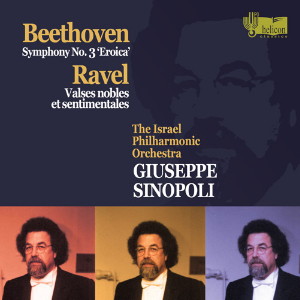
| Ludwig van BEETHOVEN
(1770-1827) |
Symphony No. 3 in
E flat major, Op. 55 "Eroica" |
|
50' 19" |
|
|
-
I. Allegro con brio |
15' 24" |
|
|
|
-
II. Marcia funebre: Adagio assai |
17' 09" |
|
|
|
-
III. Scherzo: Allegro vivace |
5' 38" |
|
|
|
-
IV. Finale: Allegro molto |
12' 08" |
|
|
|
|
|
|
|
| Maurice RAVEL
(1875-1937) |
Valses
nobles et sentimentales |
|
17' 17" |
|
|
-
I. Moderé |
1' 20" |
|
|
|
-
II. Assez lent |
2' 42" |
|
|
|
-
III. Moderé |
1' 43" |
|
|
|
-
IV. Assez animé |
1' 40" |
|
|
|
-
V. Presque lent |
1' 13" |
|
|
|
-
VI. Vif |
0' 55" |
|
|
|
-
VII. Moins vif |
3' 30" |
|
|
|
-
VIII. Epilogue: Lent |
4' 14" |
|
|
|
|
|
|
|
| THE ISRAEL
PHILHARMONIC ORCHESTRA |
|
| Giuseppe SINOPOLI |
|
|
|
|
|
Luogo
e data di registrazione |
|
Mann
Auditorium, Tel-Aviv (Israele) -
28 ottobre 1993 |
|
|
Registrazione:
live / studio |
|
live
recording
|
|
|
Producer |
|
Yaron
Karshai |
|
|
Recording
producer |
|
Yuval
Karin |
|
|
Recording
engineer |
|
Eitan
Shamai |
|
|
Mastering |
|
Rafi
Eshel |
|
|
Prima Edizione
LP |
|
- |
|
|
Prima Edizione
CD |
|
Helicon
Classics | 02-9653 | 1 CD - 68' 05" | (p)
& (c) 2012 | DDD
|
|
|
Note |
|
-
|
|
|
|
|
|
|
|
|
Ludwig van
Beethoven: Symphony No. 3
in E flat major, Op. 55
"Eroica"
Beethoven's view of himself
as an independent artist was
in keeping with the spirit
of his tumultuous times, the
era of the French Revolution
and the Napoleonic Wars. The
first major composer not to
seek court or church
appointments, Beethoven
preferred to work with the
sponsorship of aristocratic
patrons, and on musical
projects primarily of his
own choosing.
His imagination was ignited
by Napoleon, who, as First
Consul of the new French
Republic, seemed to embody
the ideals of the
Revolutionary Era. Beethoven
started work on his Third
Symphony with the intention
of entitling it "Bonaparte".
But soon Napoleon crowned
himself Emperor, becoming in
the composer's view "only
another tyrannical despot,"
and abandoning human values
which Beethoven delt could
not be compromised.
Though musical historians
caution that many anecdotes
about Beethoven's stormy
behavior cannot be
substantiated, there is no
boubt that his revulsion at
Napoleon's ascension to the
throne found violent
expression. On the
hand-written title page of
one copy of the score,
Beethoven erased the name
"Bonaparte" so vehemently
that he tore through the
paper. Beethoven ultimately
wrote on the title page, in
Italian, "Heroic Symphony"
(Sinfonia Eroica), "composed
in memory of a great man."
There has been
speculation that the
symphony expresses, in the
wordless yet profoundly
articulate language of
Beethoven's music, not only
the extra-musical concept of
heroism - the title admits
as much - but also an
overall narrative shape. In
this context, is the
composer's designation of
the second movement, Funeral
March, more than a merely
musical title? If so, do the
other movements also have
meanings, though
unspecified? The most
probable answer is that the
symphony, certainly inspired
by the idea of heroism, may
even be "about" it, but not
in the literal, descriptive
or programmatic sense of
Richard Strauss's Ein
Heldenleben (A Hero's Life),
for example. The narrative
quality of the Eroica is a
purely musical experience.
The eighteenth-century
tradition of the slow
introduction (which
Beethoven follows in hi
first two symphonies) is
decisively and brusquely
shattered by the two short,
loud chords which introduce
the Eroica. The first theme
is scarcely more than the
tonic triad, but presented
with a surprise twist (the
enharmonic flat seventh in
bar seven) which has melodic
and harmonic implications
Beethoven soon exploits.
This first movement was the
longest yet written in the
traditional sonata-allegro
form (exposition -
development - recapitulation
- coda). But it seems taut
and concise due to the
brevity and simplicity of
the themes, and because of
Beethoven's thoroughness in
working out the
possibilities of his
material. The development
section builds to a tutti
passage of sustained
dissonances which, though
they resolve harmonically,
must have been shocking at
the premiere in 1805, and
sound even today as though
they connote struggle or
battle. The abrupt retreat
from this high-point
(staccato quarter-notes in
the strings) is a transition
to a new melody - unexpected
in the middle of a
development section - played
in E minor by the oboe. The
recapitulation is
anticipated by a tentative
incantation of the
movement's first theme, the
second horn outlining the
tonic chord against the
violins' faint suggestion of
an incomplete dominant chord
(an unorthodoxy assumed by
early listeners to be a
wrong entrance by the second
horn player). The coda,
which is almost as long as
the recapitulation, returns
briefly to the new melody
from the development section
before concentrating on
further elaboration of the
main theme.
Neither the simple formal
outline of the Marcia
funèbre nor the movement's
direct emotional message
requires explanation. But it
does pay to remember that
most music, even the art of
great composers, was based,
as a point of departure, on
one or another of the common
types of music familiar to
the general public at the
time of composition. That
familiarity was a basis of
communication from composer
to listener. Taday's
listener, for example,
recognizes parody in Mahler
- sometimes intentionally
grotesque, macabre, or
ironic - of certain types of
music: waltzes and other
dances, military marches,
hymns and popular song. The
listener should also
recognize these and other
types of music, usually
without parody or irony, in
the works of almost all
eighteenth and
nineteenth-century
composers. It is not by
accident that the first
movement of this symphony
resembles a waltz (which
already existed in
Beethoven's time). In the
second movement, the rhythm
and cadence of a military
funeral march are still
familiar - and the impact is
still immediate. Beethoven's
use of the double basses to
conjure the effect of a
snare drum (writing a bass
part separate from the
'celli, unusual at that
time) lends a particularly
lugubrious tone to the
beginning. The short
interlude in C major, with
its brassy recollection of
triumph, leaves the eye no
drier than the sustained
grief of the long fugal
passage which flows from the
next recitation of the march
music. As the movement
reaches its end, the march
is played only in fragments,
like halting speech choked
by grief (an expressive
device used again by
Beethoven at the end of his
powerful Coriolan Overture).
Except in his
Eighth Symphony, Beethoven
replaces the courtly minuet
of the eighteenth-century
symphony with his own rapid,
bustling Scherzo, also in
3/4-time, but so quick that
there is only one beat to
the bar. This movement
dances with lightness and
power, an impression created
in part by the running
staccato quarter notes,
often with larger intervals,
of the bass line. The
unusual use of three horns
in the same key (rather than
the standard pair, or the
occasional two pairs in
different keys) is
highlighted in the Trio
section, which is French
hunting-horn music refined
to suit Beethoven's
expressive purpose. Toward
the end of the Scherzo's
reprise, four bars in duple
time - a simple but
startling effect - are one
example of the freedom and
inventiveness Beethoven had
already developed in this
new style.
The Finale is a set of
variations, some of them
with fugal passages, and the
last several of them
encompassing two changes of
tempo. The highseriousness,
learned craft and noble
inspiration of this music do
not eclipse Beethoven's
outrageous, titanic sense of
humor, which is impossible
to ignore at the beginning
of the movement. The
tremendous flourish of the
opening measures introduces
the most comically pithy of
tunes, played slowly and
pizzicato, on which the
first two variations are
based. But this tune turns
out to be only the bass line
of the actual theme,
eventually played in full by
the oboe. It comes from
Beethoven's earlier ballet
Prometheus and was also the
subject of his Variations
and Fugue on a Theme from
"Prometheus" for piano (now
usually knows as the
"Eroica" Variations). The
significance of this theme
may be more than purely
musical, but if Beethoven
had Prometheus in mind, it
was more likely in
connection with himself as a
creative artist - a creative
force - than with any
long-faded admiration for
Napoleon Bonaparte.
James
Madison Cox
Maurice
Ravel: Valses nobles
et sentimentales
This work by Ravel is a
homage to Franz
Schubert. Ravel himself
stated that its title,
in which two Waltz
cycles by Schubert are
mentioned (Valses Nobles
and Valses
Sentimentales), clearly
indicates his intention
to compose a sequence of
waltzes based on
Schubert. Like many of
Ravel's works, it was
first written for piano
and later orchestrated
by the composer. The
piano version was
composed in 1911 and
although Ravel was still
a controversial figure
at the time, his
reputation as one of
France's greatest
composers had already
been established. The
first public performance
of the Waltzes, by
pianist Louis Aubert, to
whom the work was
dedicated, was booed by
the audience. One year
later, Ravel
orchestrated the work as
ballet music entitled
Adélaide, or the
Language of Flowers. He
also wrote the ballet
plot and conducted the
premiere in April 1912.
This version was
received much more
favorably than the
original one.
The ballet takes place
in Paris around the year
1820, in the salon of
the courtesan Adélaide
has two suitors: the
Duke, who offers her
wealth, and Lorédan,
offering her true love.
The eight Waltzes depict
the eight scenes of the
ballet. The first Waltz
is vigourous and
festive, "spiced" with
Ravelian dissonances.
The scene takes place in
Adélaide's salon, where
couples are dancing and
courting each other
while Adélaide, the
hostess, comes and goes.
The second Waltz depicts
Lorédan's entrance in a
melancholy atmosphere.
He gives Adélaide a
buttercup, a symbol of
love. The music is
written in restrained
elegance with a touch of
sadness prominent in the
elegiac theme. In the
third Waltz, Adélaide
plucks the petals of the
flower one after the
other (like the game "He
loves me, he loves me
not") and discovers that
Lorédan truly loves her.
This Waltz is followed
without a break by the
fourth Waltz, in which
Adélaide and Lorédan
dance together and seem
very much in love. The
moment Adélaide sees the
Duke, she stops dancing.
This Waltz also leads
directly to the
following one. In the
fifth Waltz, the Duke
gives Adélaide
sunflowers and a diamond
necklace, which she
immediately puts on. In
the sixth Waltz
desperate Lorédan tries
his luck once again, but
is rejected by Adélaide.
The seventh Waltz opens
with the Duke begging
Adélaide to save the
last dance for him, but
she refuses and leaves
to look for Lorédan.
Many parts of the final
Waltz resemble fragments
of melodies from the
preceding Waltzes. The
guests leave and the
Duke, who hopes that
Adélaide will ask him to
stay, receives a bunch
of acacia flowers, a
symbol of Platonic love.
He leaves angrily and
Adélaide gives Lorédan a
poppy, a symbol of
forgetfulness. He
rejects the flower and
leaves in despair, only
to return with a gun in
his hand, which he aims
at his head. Adélaide
offers him a red rose
and falls into his arms.
Orly
Tal
|
|
|