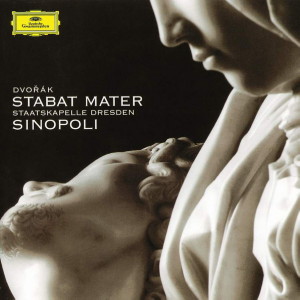
 |
|
DG - 2
CDs - 471 033-2 - (p) 2001
|
|
| Antonín DVOŘÁK
(1841-194) |
|
|
|
|
|
|
|
Compact Disc 1
|
|
54' 27" |
|
| Stabat Mater, Op.
58 |
|
87' 34" |
|
| -
I. Quartetto e Coro. Andante con
moto "Stabat Mater dolorosa" |
20' 36" |
|
|
| -
II. Quartetto. Andante sostenuto
"Quis est homo, qui non fleret" |
11' 27" |
|
|
| -
III. Coro. Andante con moto
"Eja, Mater, fons amoris" |
7' 49" |
|
|
| -
IV. Basso solo e Coro. Largo
"Fac, ut ardeat cor meum" |
9' 45" |
|
|
| -
V. Coro. Andante con moto, quasi
allegretto "Tui nati
vulnerati" |
4' 50" |
|
|
| Compact Disc 2 |
|
33' 07" |
|
| -
VI. Tenore solo e Coro. Andante
con moto "Fac me vere tecum
flere" |
6' 49" |
|
|
| -
VII. Coro. Largo "Virgo
virginum praeclara" |
6' 35" |
|
|
| -
VIII. Duo. Larghetto "Fac,
ut portem Christi mortem" |
4' 42" |
|
|
| -
IX. Alto solo. Andante maestoso
"Inflammatus et accensus" |
6' 16" |
|
|
| -
X. Quartetto e Coro. Andante con
moto "Quando corpus morietur" |
8' 45" |
|
|
|
|
|
|
| Mariana ZVETKOVA,
soprano |
CHOR DER SÄCHSISCHEN
STAATSOPER DRESDEN |
|
| Ruxandra DONOSE,
mezzo-soprano |
Matthias Brauer,
chorus master |
|
| Johan BOTHA,
tenor |
STAATSKAPELLE
DRESDEN |
|
| Roberto SCANDIUZZI,
bass |
Giuseppe SINOPOLI |
|
|
|
|
|
Luogo
e data di registrazione |
|
Sächsische
Staatsoper, Dresden (Germania) -
aprile 2000 |
|
|
Registrazione:
live / studio |
|
live
recording
|
|
|
Executive
Producer |
|
Ewald
Markl |
|
|
Recording
Producer |
|
Sid
McLauchlan |
|
|
Tonmeister
(Balance Engineer) |
|
Klaus
Hiemann |
|
|
Recording
Engineers |
|
Jürgen
Bulgrin, Hans-Ulrich Bastin |
|
|
Editing |
|
Oliver
Rogalla |
|
|
Prima Edizione
LP |
|
- |
|
|
Prima Edizione
CD |
|
Deutsche
Grammophon | 471 033-2 | 2 CDs -
54' 27" - 33' 07" | (p) 2001 | DDD
|
|
|
Note |
|
-
|
|
|
|
|
|
|
|
|
The year 1875
was something of an annus
mirabilis for Dvořák:
in just twelve months he
composed his Fifth Symphony,
the E major String Serenade,
three important chamber
works, four Moravian Duets
and the five-act grand opera
Vanda. It also marked
both a peak in his fortunes
- for the first time he
received a state prize to
help struggling young
artists - and a year of deep
personal sadness for the
composer and his wife Anna,
with the death on 19
September of their infant
daughter Josefa.
The effect of this event on
Dvořák
may be sensed in the
expressive G minor Piano
Trio he wrote in January
1876, and shortly afterwards
he may have decided to
commemorate his loss with
this setting of the Stabat
Mater,
his longest and most
profound non-operatic work
to date. He sketched it
between 19 February and 7 May
1876, but left the
orchestration until autumn
of the following year, the
interruption perhaps caused
by continuing, devastating
family tragedies: the death
of another daughter, Růžena,
followed a few weeks later
by the loss of the Dvořák’s
sole surviving child, their
son 0takar. The
orchestration was eventually
completed on 13 November
1877, and the premiere took
place at an anniversary
concert of the Prague
association of musical
artists (Umĕlecká
beseda) on 23 December 1880,
a curiously unseasonable
date for such a
quintessentially Passiontide
composition.
The first performers of the
Stabat Mater
were an imposing
group: the soloists -
Eleanora Ehrenbergová,
Betty Fibichová,
Antonín
Vávra
and Karel Čech
- were the most
distinguished singers of the
Prague Provisional Theatre;
the orchestra and choir were
also provided by the
theatre’s personnel; and the
conductor was Dvořák's
friend Adolf Čech.
Even so, it is unlikely that
the forces were large; the
choir probably comprised
some 40 singers and the
orchestra only about 30
players. A second
performance took place in
Brno on 2 April 1882,
conducted by Dvořák’s
good friend Leoš Janáček;
but the work’s highly
successful London
premiere on 10 March
1883 in the Royal Albert
Hall, with considerably
larger performing forces,
was of far greater
significance for Dvořák’s
burgeoning fame outside
his native land. This
event did much to
establish his reputation
among the oratorio-loving
English public and led to
an invitation to conduct
another performance in
London the following year.
These early contacts with
concert-giving bodies in
England resulted in a
number of important choral
commissions, including the
Requiem Mass
for the 1891 Birmingham
Festival.
Dvořák’s
setting of the Stabat
Mater a medieval
liturgical text that
serves both as a sequence
for the Feast of the Seven
Dolours and as an Office
hymn for Good Friday, is
the longest by any major
composer. The score
appears to owe nothing to
a specific model - such
settings were not common
in 19th-century Prague
(although a Stabat
Mater was composed
later by Dvořák’s
friend and younger
contemporary Josef
Bohuslav Foerster
[1859-1951]) - yet it
reveals much about the
composer and his
influences. His highly
developed symphonic
instinct informs its
larger structures - in
fact, the first movement
is the longest span in a
work other than opera that
he had yet attempted.
There is also much in the
outer movements and the
“Eja mater” to remind us
of Dvořák's
extensive exposure to
Italian opera as an
orchestral viola player
(he retained an admiration
for Verdi until the end of
his days). And
underpinning the work’s
lyricism and craftsmanship
is Dvořák`s
solid grounding in Baroque
compositional stylistic
procedures.
An affective Baroque
figure provides the basis
for the opening movement
(“Stabat Mater dolorosa”).
From the very beginning
there is a sense of epic
tragedy in the unfolding
of the musical ideas: the
rising notes at the start
seem, as Šourek
pointed out in his seminal
study of Dvořák’s
life and music, to evoke a
picture of the Virgin
looking up at her dying
son on the cross. ln the
ebb and flow of this
superbly sustained
movement the music
frequently rises towards
climaxes, but on each
occasion a savage
diminished chord snuffs
out the aspiration towards
resolution. The second
movement, for solo
quartet, contrasts the
question “Who
would not weep to see the
mother of Christ", in
sombre E minor, with an
affecting major-key
setting of the text
dealing with Christ’s
suffering on the cross. A
single verse of the hymn,
“Eja Mater",
sustains a broad and
dramatic movement whose
march-like outer sections
are relieved by its
exquisitely lyrical
secondary material. The
fourth movement, "Fac,
ut ardeat cor meum", is a
powerful declamatory aria
for bass with gentle,
almost ethereal choral
interludes.
Dvořák's
treatment of the single
verse “Tui nati vulnerati"
in the fifth movement has
a distinctly Baroque feel,
with its flowing, almost
Bach-like counterpoint. A
suggestion of Baroque
practices is also evident
in the sixth movement,
“Fac me vere", a
chorale-like hymn for the
tenor and male chorus,
though this time the
resemblance is less to
Bach’s style than to the
manner of Dvořák’s
18th-century Czech
predecessors. In
the following exquisite
rendering of the words "Virgo
virginum praeclara", the
orchestral accompaniment
is light and frequently
disappears altogether;
shortly before the end Dvořák
adds some contrasting,
highly chromatic material.
This choral movement is
succeeded by a
marvellously understated
duet for soprano and
tenor, "Fac,
ut portem Christi mortem".
"Inflammatus
et accensus", a splendid
aria for solo alto, also
looks back to the Baroque
with its memorable
ritornello opening,
complete with "walking
bass". Determined and
lyrical by turns, this
number remained a firm
favourite with audiences
throughout Dvořák’s
lifetime.
In
the final movement the
work returns full circle
to the opening. But as the
tension builds to a
climax, instead of the
crushing diminished chord
deployed so devastatingly
before, the music resolves
onto a radiant D major at
the words "Paradisi
gloria". A flowing
contrapuntal “Amen”
provides an impressive
peroration for soloists
and chorus, the high point
of which is a supremely
stirring, chorale-like
setting of the hymn's
final words. This
generates a grand final
cadence, but the
conclusion of the mighty
whole is as hushed as its
beginning.
Jan
Smaczny
|
|
|