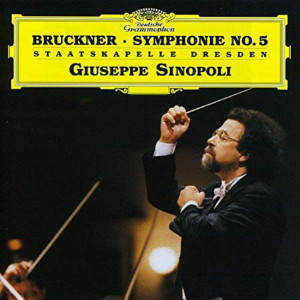
 |
|
DG - 1
CD - 469 527-2 - (p) 2001
|
|
| Anton BRUCKNER
(1824-1896) |
|
|
|
|
|
|
|
| Symphonie No. 5
B-dur |
|
76' 37" |
|
| Edition:
Leopold Nowak |
|
|
|
| -
1. Introduction.
Adagio - Allegro |
20' 51" |
|
|
| -
2. Adagio- Sehr langsam |
18' 48" |
|
|
| -
3. Scherzo. Molto vivace
(schnell) - Trio. Im gleichen
Tempo |
13' 30" |
|
|
| -
4. Finale. Adagio - Allegro moderato |
23' 28" |
|
|
|
|
|
|
| STAATSKAPELLE
DRESDEN |
|
| Giuseppe SINOPOLI |
|
|
|
|
|
Luogo
e data di registrazione |
|
Semperoper,
Dresden (Germania) - marzo 1999 |
|
|
Registrazione:
live / studio |
|
live
recording
|
|
|
Executive
Producer |
|
Ewald
Markl |
|
|
Recording
Producer |
|
Arend
Prohmann |
|
|
Tonmeister
(Balance Engineer) |
|
Klaus Hiemann |
|
|
Recording
Engineer |
|
Jürgen
Bulgrin, Wolf-Dieter Karwatky |
|
|
Post-Production |
|
Oliver
Rogalla |
|
|
Prima Edizione
LP |
|
- |
|
|
Prima Edizione
CD |
|
Deutsche
Grammophon | 469 527-2 | LC 0173 |1
CD - 76' 37" | (p) 2001 | DDD
|
|
|
Note |
|
-
|
|
|
|
|
|
|
|
|
The February
of 1875, when he began
composing his Fifth
Symphony, found Bruckner
isolated and ill at ease in
Vienna. The city’s
sophisticated atmosphere and
manners little suited him,
he was poorly paid for his
teaching at the
Conservatory, and the Vienna
Philharmonic had dismissed
his Third Symphony as
“unplayable” after a trial
performance. If he
found difficulty in
protecting himself from his
enemies, in particular the
phalanx of critics led by
the powerful Eduard
Hanslick, he also needed
preservation from his
friends; for, in an effort
to win his music acceptance,
some of them set about
revising and rewriting the
symphonies so as to make
them more palatable to the
Viennese audience. Savage
cuts were inflicted, and the
music was reorchestrated,
often in a style closer to
that of Bruckner's
most influential admirer, Richard
Wagner.
Beset with self-doubt,
Bruckner accepted this
interference and was even
persuaded to make revisions
himself. In
well-meaning attempts to get
the music some sort of a
hearing, there were public
performances in two-piano
arrangements; and, indeed,
the only penformance of the
Fifth Symphony that the
composer ever heard was
given in this form, by Franz
Schalk and Franz Zottmann.
Schalk later conducted his
own cut and re-orchestrated
version of the work in Graz
on 9 April 1894, one which
would have appalled Bruckner
even more had he been well
enough to travel to hear it.
The whole history of
Bruckner revisions is a
notoriously complicated one;
suffice it to say that
nowadays the most widely
accepted version of this
symphony (as of others) is
Bruckner's own original, as
recorded here, which he
largely completed in 1876,
making some slight revisions
in 1877-78.
In defence of Bruckner’s
opponents, it may be said
that the symphonies’ originalities
would have seemed the more
confusing to Viennese
audiences that saw
themselves as partakers in a
tradition handed down from
Haydn and Mozart by way of
Beethoven and Schubert to
its current legatee,
Johannes Brahms. Even today,
when he has long been
accepted as a composer of
world stature, Bruckner's
music seems disconcertingly
different from that of his
symphonic forebears. Those
approaching the Fifth
Symphony, for instance, one
of the grandest and most
original of the entire
cycle, will not find a first
movement that gives them two
contrasting themes and then
takes them through
development and finally
recapitulation as, in their
different ways, Bruckner's
predecessors do. He is
concerned more with setting
out and exploiting
contrasted musical gestures.
The Fifth opens on strings
with a trudging bass figure
and soft, mysterious
counterpoint; after a brief
silence, there is a blaze of
sound on wind and brass;
then the tempo speeds up on
strings until a true Allegro
is reached with a new theme
under the high tremolo
strings that are a familiar
Bruckner fingerprint. The
relationships between these
very different musical
gestures only gradually
reveal themselves,
especially as Bruckner takes
his time with modifying them
and disclosing their
kinship.
There is also an
unfamiliarity in Bruckner‘s
use of keys. Few listeners,
as they follow the music,
will consciously concern
themselves with the fact
that Bruckner is making much
play with the engagement
between B flat (the opening
and closing key of the
symphony) and D, the key of
the two central movements.
Yet it is this contest,
waged with particular
subtlety within the first
movement, that gives the
music its particular
flavour; heard perhaps most
immediately as a series of
surprising shifts across
keys as the main thematic
components realign
themselves one with another.
It
remains astonishing music,
but for the listener in
sympathy with Bruckner, it
is his judgement and that of
no opponent or interferer
which is to be trusted.
The slow movement, which
Bruckner began first, is in
a more familiar melodic
vein, with a bleak oboe
theme over pacing triplets,
later a powerful violin
song; and the Scherzo
maintains the classical
balance between a fastmoving
melody, close in spirit to
the Ländler
of Bruckner’s country
origins, and a contrasting
Trio. But Bruckner has not
abandoned the subtle
thematic connections of the
first movement; and when he
comes to the finale, it is
to reaffirm these with a
breathtakingly bold gesture,
invoking Beethoven‘s Ninth
Symphony in his recall of
themes from the previous
movements. Yet whereas
Beethoven reflected upon
these in order to discard
them in favour of “a new
song”, Bruckner gathers his
material together in a
renewed symphonic effort. All his
craft is brought to bear
upon the music - and we
remember that it was a craft
learned inthe organ loft -
so that fugal writing plays
its part, as also, in a
superb climax, does a
chorale on brass, a
tremendous full orchestral
statement of which brings
the symphony home in B flat.
This was the
most powerful symphony
Bruckner had yet written,
and the most puzzling.
Brahms, though personally
courteous to the composer,
could not find it in
himself to be sympathetic
to the music.
Significantly, it was
contemporaries belonging
to a newer movement in
music who rallied to this
master of a form they
themselves had largely
discarded - Hugo
Wolf, fervent in his
writings on Bruckner’s
behalf, Liszt,
harmonically most forward-looking
of them all,
Wagner, whose
death, before he
could conduct a promised
cycle of the symphonies,
left Bruckner heartbroken.
John
Warrack
|
|
|