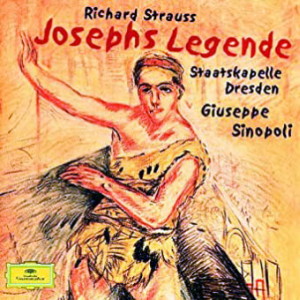
In 1912 the poet
Hugo von Hofmannsthal had an
inspiration while attending a
performance of Diaghilev's
Ballets Russes. Since the
Paris season of 1909, the
company had been the talk of
the arts world. With his
friend Count Harry Kessler,
that enigmatic, shadowy German
diplomat and littérateur
who turns up in so many
memoirs of the period and had
invented most of the plot of Der
Rosenkavalier,
Hofmannsthal picked a biblical
subject, the young Joseph and
his attempted seduction by
Potiphar's wife, and sold the
idea to Diaghilev. The role of
Joseph, of course, would be
danced by Nijinsky, and the
music would be by Richard
Strauss.
Strauss liked the idea (he too
had seen the Ballets Russes in
Berlin) and began work. But
Kessler's wordy and
pretentious scenario ("Joseph
becomes a mystical figure. But
his mysticism is not that of
Parsifal. His mystery is that
of growth and being.") was not
of the kind to appeal to the
worldly, anti-religious
Strauss. So in September he
confessed that he was stuck.
"The chaste Joseph isn't at
all up my street and if a
thing bores me I find it
difficult to set to music.
This God-seeker Joseph, he's
going to be a hell of an
effort!"
We hear no more of the project
until mid-December 1912 when
Strauss played what he had
composed so far to
Hofmannsthal, who was
"perturbed" by the music for
Joseph, finding it too
Mozartian and 18th-century.
"Nijinsky implores you to
write the most unrestrained,
the least dance-like music in
the world, to put down pure
Strauss for this leaping
towards God." Six months later
Strauss said he would "try to
get down to Joseph,
which our dear old Count
Kessler is doing his best to
make palatable to me... But
artistic creation can't be
commanded". In July 1913 he
reported that he had finished
the new sletch for Joseph's
dance. Two months later he had
scored 100 pages, "but it's a
big and laborious job". He
raided the sketches of his
discarded 1900 ballet Kythere
for some of the material and
completed the full score in
Berlin on 2 February 1914. It
is composed for a huge
orchestra, even by Strauss
standards, including a
contrabas clarinet. Although
the score is sumptuous and
contains some marvellous
melodies, notably that for
Potiphar's Wife, italso bears
the impression that Strauss
was put off by Hofmannsthal’s
penchant for symbolism and
regarded the work as a way of
passing time until the poet
came up with Die Frau ohne
Schatten. And yet...
such is Strauss’s seductive
magic that it has never
completely faded away and in
recent years has even found
new favour. Echoes of Salome
and anticipations of Die
Frau ohne Schatten
abound, and it can claim some
originality in its approach to
dance.
The première was
planned for the Paris Opéra on
14 May 1914. Already there was
thunder in the air
internationally. In the ballet
world, too: shortly before the
première Nijinsky was married,
which caused a total break
with his lover Diaghilev. So
Joseph was danced by the young
Léonide Massine (“weaker and
not quite adequate” was
Strauss’s verdict). Potiphar’s
Wife was danced by Maria
Kuznetsova, mistress of Léon
Bakst, who designed the
costumes. The set, magnificent
from all accounts, was
designed by José-Maria Sert
and the choreography instead
of being by Nijinsky was by
Mikhail Fokine, who also
directed. Strauss conducted
and had trouble at rehearsals
with an orchestra which
operated on the pernicious
“deputy” system whereby
players could send substitutes
if they had another
engagement. Nevertheless he
took len curtain calls after
the performance, which shared
the bill with Les
Papillons and Scheherazade,
both conducted by Monteux. Six
performances followed in
London at Drury Lane,
conducted by Beecham.
Potiphar’s Wife was danced at
some performances by Tamara
Karsavina. Strauss was
conscious of anti-German
feeling but told Hofmannsthal
it had been “a great success
in spite of the fact that most
of the press was hostile and
even the most sophisticated
Englishwomen found the piece
indecent”.
Within a few weeks
of the performances of Josephs
Legende, Britain, France
and Germany were at war.
Strauss’s savings, deposited
with an English banker, were
confiscated and Diaghilev
never paid him his conducting
fee of 6,000 gold francs.
After the war, the ballet was
revived in Berlin, Vienna,
Munich and elsewhere. In 1947
Strauss produced a 23-minute Symphonic
Fragment, with reduced
orchestration, which omits the
music for Joseph’s threatened
torture and Potiphar’s wife’s
suicide. It retains the erotic
charge that is the most
compelling feature of a work
that might have been designed
to bring down the curtain on a
world that ended in 1914.