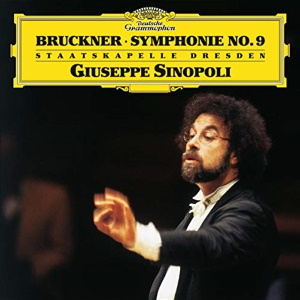
 |
|
DG - 1
CD - 457 587-2 - (p) 1999
|
|
| Anton BRUCKNER
(1824-1896) |
|
|
|
|
|
|
|
| Symphonie Nr. 9
d-moll |
|
62' 13" |
|
| Edition:
Leopold Nowak |
|
|
|
| -
1. Feierlich, Misterioso |
25' 42" |
|
|
| -
2. Scherzo.
Bewegt, lebhaft - Trio. Schnell |
10' 15" |
|
|
| -
3. Adagio.
Langsam, feierlich |
26' 16" |
|
|
|
|
|
|
| STAATSKAPELLE
DRESDEN |
|
| Giuseppe SINOPOLI |
|
|
|
|
|
Luogo
e data di registrazione |
|
Semperoper,
Dresden (Germania) - marzo 1997 |
|
|
Registrazione:
live / studio |
|
live
recording
|
|
|
Executive
Producer |
|
Ewald
Markl |
|
|
Recording
Producer |
|
Werner
Mayer |
|
|
Tonmeister
(Balance Engineer) |
|
Klaus
Hiemann |
|
|
Recording
Engineers
|
|
Rainer
Hoepfber, Wolfgang Werner |
|
|
Editing |
|
Ingmar
Haas
|
|
|
Prima Edizione
LP |
|
- |
|
|
Prima Edizione
CD |
|
Deutsche
Grammophon | 457 587-2 | LC 0173 |1
CD - 62' 13" | (p) 1999 | 4D DDD
|
|
|
Note |
|
-
|
|
|
|
|
|
|
|
|
The son of an
Upper Austrian village
schoolmaster, Bruckner lived
simply as a teacher and
organist; only in his early
30s
did he seriously begin
composition. A humble,
modest and eccentric
personality, his life and,
as a consequence, his music,
was dedicated to the glory
of God. It
took until the 1880s before
his work began to receive
the recognition and success
it deserved. True he had his
disciples and admirers,
among them the composer Hugo
Wolf and the conductors
Ferdinand Löwe.
Franz Schalk and later Artur
Nikisch and Hans Flichter.
But in general his was a
life battered and bruised by
critical reception, mostly
at the expense of the
enormously influential
Viennese critic Eduard
Hanslick. Bruckner fervently
admired Wagner and dedicated
his Third Symphony to the
German composer, but by
allying himself to the Master
of Bayreuth he alienated
himself from much of the
Viennese public who
preferred Brahms, who lived
in their midst. Much
had been made of this
schism, but in reality
Brahms, Wagner and Bruckner
held each other in mutual
regard despite their widely
differing personalities. It
was mischief-making among
their supporters which did
the damage.
Bruckner was a
perfectionist and extremely
sensitive to comment and
criticism. Following the
success of the Seventh
Symphony under Nikisch at
Leipzig in December 1884 (a
triumph which began to
spread the composer`s name
far and wide) he began to
discover in himself a
self-confidence which had
been sadly lacking before.
He began to sketch out his
Ninth Symphony in 1887 just
a couple of days before
completing the final touches
to his massive Eighth, which
he sent off to the conductor
Hermann Levi. This proved
his undoing, for Levi
confessed himself totally
bewildered by the work and
declined to conduct it,
Bruckner was shattered and
immediately set to work
revising and rescoring not
only the Eighth but also
making further revisions to
his first three symphonies.
The result was that the
Ninth was consigned to the
back burner, and eventually
it took the nine remaining
years of Bruckner’s life to
complete the three extant
movements we have today.
Perhaps if Richter (who in
the end conducted the
premiere of the Eighth in
1892) had been the recipient
rather than Levi,
we would have a finale for
the Ninth. As death
approached, in the autumn of
1896, Bruckner’s friends
realized that it was not to
be forthcoming. Richter even
suggested to him that his Te
Deum might make a fitting
conclusion in the way that Beethoven’s
Ninth had a triumphant
choral ending, and,
according to the conductor,
Bruckner was not averse to
the idea. It was followed at
the first performance in
February 1903, under Löwe,
but the result was far
from satisfactory. It
took until 1932 before the
authentic version of the
symphony was heard. Mercifully
the 200 or so pages of
sketches for the fourth
movement that remain do not
provide the basis for
someone to complete what is
already in itself a fitting
conclusion to Bruckner’s
life. His
earlier symphonies often
resolve the anguish of his
complex personality in their
first three movements by a
triumphant finale in which
the Greater Glory of God
seems to have a hand. It is
fitting that the Ninth,
without any such resolution,
stands alone as a stark
statement of the mans
character.
Beethoven's influence is
evident from the outset,
building from a hushed
tremolo of strings (also
found in Bruckner’s First
and Fourth Symphonies) to a
massive unison outburst of
the full orchestra. It
develops into one of the
most original of movements,
with the borders of
conventional sonata form
(exposition, development and
recapitulation) far less
discernible than his
previous symphonies. The
essential and familiar
Brucknerian ingredients,
those terraced blocks of
sound, the organist’s feel
for registration and tonal
colour, are all there, so
too is the contrast between
noble themes and stark,
angular motifs. The scherzo
comes next (as it does in
only his String Quintet and
the Eighth Symphony), and
though it may appear to be a
danse macabre with an
even faster trio section, it
also provides a necessary
contrast to the tensions of
the first movement. With
the concluding Adagio,
described by many as
Bruckner’s farewell to life
and reportedly by himself as
"the
finest I have ever written,
it impresses me whenever I
play it", Bruckner uses two
alternating themes, the
first comprised of
wide-arching intervals, the
second an expansive melody
given to the violins. After
a climax of agonized
dissonance (no visionary
grand apotheosis here as in
the Adagios of the preceding
Seventh and Eighth
Symphonies) there descends
an uneasy peace, one which
might have been resolved in
that elusive missing finale.
Christopher
Fifield
|
|
|