 |
|
EMI -
1 CD - 7243 5 56535 2 9 - (p) 1998
|
|
| Franz Joseph
HAYDN (1732-1809) |
|
|
|
|
|
|
|
| Concerto for
Cello and Orchestra in C, Hob.
VIIb:1 |
|
25' 08" |
|
-
I. Moderato (Cadenza "added to the
source by another hand at an early
date")
|
9' 42" |
|
|
| -
II. Adagio (Cadenza "added to
the source by another hand at an
early date") |
8' 35" |
|
|
| -
III. Finale. Allegro molto |
6' 50" |
|
|
| "Lo
speziale": Dramma giocosa -
Sinfonia (Overtura) in G, Hob.
Ia:10 |
|
6' 15" |
|
| -
Presto |
2' 51" |
|
|
| -
Andante |
2' 51" |
|
|
| -
Presto |
0' 32" |
|
|
| Concerto for
Cello and Orchestra in D, Hob.
VIIb:2 |
|
26' 08" |
|
| -
I. Allegro moderato (Cadenza:
Mstislav Rostropovich) |
15' 22" |
|
|
| -
II. Adagio (Cadenza: MAurice
Gendron) |
5' 56" |
|
|
| -
III. Rondo. Allegro |
4' 50" |
|
|
|
|
|
|
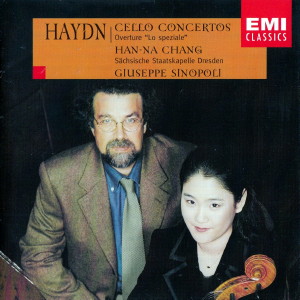
| HAN-NA CHANG,
violoncello |
|
| SÄCHSISCHE STAATSKAPELLE
DRESDEN |
|
| Giuseppe SINOPOLI |
|
|
|
|
|
Luogo
e data di registrazione |
|
Lukaskirche,
Dresden (Germania) - settembre
1997 |
|
|
Registrazione:
live / studio |
|
studio
|
|
|
Producer |
|
David
Groves |
|
|
Balance
Engineer |
|
Simon
Rhodes |
|
|
Editor |
|
Caroline
Haigh
|
|
|
Prima Edizione
LP |
|
- |
|
|
Prima Edizione
CD |
|
EMI |
7243 5 56535 2 9 | 1 CD - 57' 33"
| (p) 1998 | DDD
|
|
|
Note |
|
-
|
|
|
|
|
|
|
|
|
Joseph Haydn
was born into a
working-class family in
Lower Austria in 1732. He
selected a career as a
musician but found it
difficult to secure
employment. After losing his
post as a choirboy in St
Stephen’s Cathedral, Vienna,
when his voice broke in
1750, he taught, played in
street bands, and lived in
sparse, cold, cramped
accommodation, studying and
composing (“though not too
correctly," he admitted
later). Eventually he found
patrons, but when Count Morzin,
his employer, hit hard times
Haydn and the court musical
establishment were
dismissed. Haydn’s luck and
musical talent saved him,
however, for on 1 May
1761 he entered the service
of Prince Esterházy
as vice-Kapellmeister.
He found an expert orchestra
struggling to reach artistic
satisfaction under an ageing
Kapellmeister, Gregor Joseph
Werner, who distrusted the
newcomer and saw him as a
threat. Haydn knew how to
counter such jealousy. He
set about getting the
orchestral members on his
side by complimenting them
on their skills. For each of
his principals he composed
testing solos in his works.
They loved it! Haydn was
seen as a fresh, clever and
sympathetic young man who
knew how to please.
Doubtless his popularity
contributed towards Werner's
decline and death in 1766.
But he was nearly 73!
Cello Concerto No.
1 in C
Some of the early Concertos
Haydn wrote for his new
friends are lost (the
rediscovery of one of them
would thrill double-bass
players), as was the Cello
Concerto in C until as
recently as 1961. Oldřich
Pulkert was examining
manuscripts from Radĕnín
Castle, housed in the Prague
National Museum, and came
across the untitled
manuscript score. He
recognised it as one listed
by Haydn himself in his Entwurf-Katalog,
a draft list of his works
from about 1765 on. The
Concerto can be dated
between 1761 and 1765. It
was written almost certainly
for Joseph Weigl, who had
joined the Esterházy
band shortly before Haydn's
appointment, and who had
been amongst those whom the
composer had targeted as an
ally.
Received opinion is that
Haydn was not at his best as
a concerto composer. This is
belied by the present work,
for its quality is at least
equal to that of most
composed at that time,
yielding perhaps only to
C.P.E. Bach, who was Haydn’s
spiritual mentor. The bold
dotted opening of the first
movement is balanced by a
softer contrasting idea
before being re-established
by the entry of the soloist.
While the tutti-solo
alternation of the structure
recalls Baroque procedure,
the central section is
clearly a development of the
material, during which the
cellist is required to show
skill not only in the
virtuosity of some of the
passage-work but also in the
warmth of the lyrical
melodies.
Set
in F major, the subdominant,
the Adagio
is a characteristic
example of Haydn's early-period
"slow"
music. Its gently pulsating
accompaniment allows the
cellist to expand upon the
sinuous, delicate and
profoundly moving melody
announced at the outset by
the orchestral strings, a
melody difficult to dislodge
from one’s memory. After
this sublime interlude the
Finale comes as a shock.
Driving momentum,
scintillating writing for
the soloist and an intense
feeling of urgent joy mark
one of Haydn’s finest early
creations.
Cello Concerto No. 2 in D
Some two decades have
passed. Another time,
another milieu. In
1783 Haydn was still in
place as Kapellmeister to
the Esterházy
household, but Weigl had
gone in 1769; more
importantly, there had been
a fundamental change in
musical attitudes. Baroque
was dead, and Classicism had
gained a great depth of
feeling due to literary
influences; but it had also
acquired a certain shallow
quality. Music,
now, was both more earnest
and less earnest according
to requirements, and the
latter was affecting the
concerto form in particular.
All
was for show. Haydn’s D
major Cello Concerto, it
is said, cannot be
compared with the best. If
by “best” one means Mozart,
then rare indeed is the
composer who could survive
the comparison. But
Haydn’s Concerto does
admirably what it sets out
to do. It
was written for Anton
Krafft, Weigl’s successor
at Esterházy,
and was influenced by his
requirements as a virtuoso
showman. In Robbins
Landon's words, "...this
is a typical
eighteenth-century attempt
on the part of the
composer to display the
talents, tone and
musicianship of his
soloist".
And so it remains. The
long first movement
concentrates upon gentle
lyricism, the better to
display the cello’s
singing qualities, while
the Adagio is a
meditative piece well
suited to the instruments
elegiac nature. “Send them
home singing" seems to be
the intention behind the
jolly rondo finale, an
engaging romp rather than
a challenging exercise -
except for the soloist! In
short, Haydn's two
surviving genuine Cello
Concertos display all the
varied moods of the
instrument.
Overture: Lo speziale
in G
Haydn’s Overture to the
comic opera Lo
speziale ('The
Apothecary'), to a
libretto by Carlo Goldoni,
was composed to mark the
opening of the newly-built
private opera house on the
Esterházy
estate on Friday 5 August
1768. In
his Entwurf-Katalog
Haydn entered it as a Sinfonia,
in the Italian manner
(meaning ‘Overture‘), a
three-moveent work. The
breathless opening Presto
is succeeded by a charming
Andante in which
the single flute carries
the melody. To herald the
rise of the curtain the Presto
returns in drastically
abbreviated form.
Robert
Dearling, 1998
|
|
|