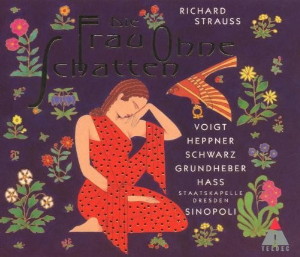
 |
|
Teldec
- 3 CDs - 0630-13156-2 - (p) 1997
|
|
| Richard
STRAUSS (1864-1949) |
|
|
|
|
|
|
|
| Die Frau Ohne
Schatten |
|
184' 21" |
|
| Oper in drei
Akten (Libretto: Hugo von
Hofmannsthal) |
|
|
|
|
|
|
|
|
Compact Disc 1 |
|
67'
55" |
|
| ERSTER
AUFZUG |
1.
"Licht überm See" - Amme,
Geisterbote |
5' 42" |
|
|
|
2.
"Amme! Wachst Du?" - Kaiser,
Amme |
5' 34"
|
|
|
|
3. "Ist mein
Liebster dagin" - Kaiserin,
Amme |
3' 52" |
|
|
|
4.
"Wie soll ich denn nicht weinen?" -
Stimme des Falken, Kaiserin, Amme |
2' 19"
|
|
|
|
5.
"Amme, um alles, wo find ich den
Schatten?" - Kaiserin, Amme |
5' 10" |
|
|
|
6.
Verwandlung: Erdenflug |
1' 40"
|
|
|
|
7.
"Dieb! Da nimm!" - Einäugiger,
Einarmiger, Buckliger, Frau, Barak |
2' 30" |
|
|
|
8.
"Sie aus dem Hause" - Frau,
Barak |
8' 14" |
|
|
|
9.
"Dritthalb Jahr bin ich dein Weib" -
Frau, Barak |
5' 35" |
|
|
|
10.
"Was vollt ihr hier?" - Frau,
Amme, Kaiserin |
6' 42" |
|
|
|
11.
"Ach Herrin, süße Herrin!" - Dienerinnen,
Kaiserin, Jüngling, Frau |
3' 37" |
|
|
|
12.
"Hat es dich blutige Tränen
gekostet" - Amme, Frau |
6' 04" |
|
|
|
13.
"Mutter, Mutter, laß uns nach
Hause!" - Kinderstimmen, Frau |
2' 33" |
|
|
|
14.
"Trag' ich die Ware selber zu Markt"
- Barak, Frau |
3' 01" |
|
|
|
15.
"Ihr Gatten in den Häisern dieser
Stadt" - Stimmen der Wächter,
Barak |
5' 22" |
|
|
|
16.
"Du bist verflucht" |
5' 08" |
|
|
|
Compact Disc 2 |
|
57'
02" |
|
| ZWEITER
AUFZUG |
1.
"Komm bald wieder nach Haus, mein
Gebieter" - Amme, Frau,
Kaiserin, Frauenchor |
4' 16" |
|
|
|
2.
"Was ist nun deine Rede, du
Prinzessin" - Barak, Brüder,
Bettelkinder, Frau |
4' 08" |
|
|
|
3.
Verwandlung |
0' 52" |
|
|
|
4.
"Falke, Falke, du wiedergefundener"
- Kaiser |
13' 38" |
|
|
|
5.
"Es gibt derer, die haben immer
Zeit" - Frau, Barak, Amme |
3' 26" |
|
|
|
6.
"Schlange, was hab' ich mit dir zu
schaffen!" - Frau, Jüngling,
Amme, Barak |
3' 12" |
|
|
|
7.
"Ein Handwerk verstehst du sicher
nicht" - Frau, Barak |
5' 42" |
|
|
|
8.
"Ich, mein Gebieter" · Verwandlung -
Kaiserin |
5' 16" |
|
|
|
9.
"Zum Lebenswasser!" - Männerchor,
Stimme des Falken |
2' 08" |
|
|
|
10.
"Wehe, mein Mann!" - Kaiserin |
3' 49" |
|
|
|
11.
"Es dunkelt, daß ich nicht sehe zur
Arbeit" - Barak, Brüder, Amme,
Kaiserin, Frau |
1' 49" |
|
|
|
12.
"Es gibt derer, die bleiben immer
gelassen" - Frau, Barak |
3' 27" |
|
|
|
13.
"Sie wirft keinen Schatten" - Brüder,
Amme, Barak, Kaiserin |
1' 52" |
|
|
|
14.
"Barak! Ich hab' es nicht getan!" -
Frau, Brüder, Amme |
3' 27" |
|
|
|
Compact Disc 3 |
|
59'
24" |
|
| DRITTER
AUFZUG |
1.
"Schweigt doch, ihr Stimmen!" - Frau |
8' 05" |
|
|
|
2.
"Mir anvertraut" - Barak, Frau |
3' 43" |
|
|
|
3.
"Auf, geh nach oben, Mann" - Stimme
von oben, Frau, Dienende Geister,
Geisterbote |
5' 02" |
|
|
|
4.
"Fort von hier" - Amme, Kaiserin |
6' 20" |
|
|
|
5.
"Aus unsern Taten steigt ein
Gericht!" - Kaiserin |
3' 18" |
|
|
|
6.
"Wehe, mein Kind" - Amme,
Sopranstimmen, Geisterbote, Stimme
der Frau, Stimme Baraks |
2' 07" |
|
|
|
7.
Verwandlung - Kaiserin, dienende
Geister, Frai, Barak |
2' 23" |
|
|
|
8.
"Vater, bist du's?" - Kaiserin,
Hüter der Schwelle, Stimme der
Frau, Stimme Baraks |
8' 47" |
|
|
|
9.
"Mein Liebster starr!" - Kaiserin,
Unirdische Stimmen, Hüter der
Schwelle, Stimme der Frau, Stimme
Baraks |
3' 33" |
|
|
|
10.
"Wenn das Herz aus Kristall" - Kaiser,
Stimmen der Ungeborenen, Kaiserin |
5' 12" |
|
|
|
11.
Verwandlung |
1' 33" |
|
|
|
12.
"Trifft mich sein Lieben nicht" - Frau,
Barak, Stimmen der Ungeborenen |
2' 29" |
|
|
|
13.
"Nun will ich jubeln" - Barak,
Kaiser, Stimmen der Ungeborenen,
Kaiserin, Frau |
4' 39" |
|
|
|
14.
"Vater, dir drohet nichts" - Stimmen
der Ungeborenen |
2' 13" |
|
|
|
|
|
|
|
| Horst HIESTERMANN,
HERODES, Tetrarch von Judäa |
CHOR DER SÄCHSISCHEN
STAATSOPER DRESDEN |
|
| Leonie RYSANEK,
HERODIAS, Gemahlin des Tetrarchen |
Matthias Brauer, Chorus
master |
|
| Deborah VOIGT, Die
Kaiserin |
STAATSKAPELLE
DRESDEN |
|
| Ben HEPPNER, Der
Kaiser |
Roland Starumer, Solo
violin |
|
| Hanna SCHWARZ, Die
Amme |
Jan Vogler, Solo
violoncello |
|
| Hans-Joachim
KETELSEN, Der Geisterbote |
Sascha Reckert, Glass
harmonica |
|
| Ute SELBIG, Ein
Hüter der Schwelle des Tempels |
Giuseppe SINOPOLI |
|
| Werner GÜRA, Die
Erscheinung eines Jünglings |
Musical assistance:
David Miller |
|
| Sabine BROHM, Die
Stimme des Falken |
|
|
| Nadja MICHAEL, Eine
Stimme von oben |
|
|
| Franz GRUNDHEBER,
Barak, der Färber |
|
|
| Sabine HASS, Sein
Weib |
|
|
| Des Färbers Brüder |
|
|
| Andreas Scheibner,
Der Einäugige |
|
|
| André Eckert, Der
Einarmige |
|
|
| Roland Wagenfèhrer,
Der Bucklige |
|
|
| Die Stimmen der
Ungeborenen |
|
|
| Roxana Incontrera, Claudia
Kuny, Helga Termer,
Elisabeth Wilke, Nadja Michael |
|
| Die Stimmen der
Wächter der Stadt |
|
|
| Hans-Joachim Ketelsen,
Matthias Henneberg, Andreas
Scheibner |
|
| Die Dienerinnen |
|
|
| Christiane Hossfeld,
Barbara Hoene, Angela Liebold |
|
|
|
|
|
Luogo
e data di registrazione |
|
Semperoper,
Sächsische
Staatsoper,
Dresden (Germania)
- novembre/dicembre 1996 |
|
|
Registrazione:
live / studio |
|
Based
on live performances
|
|
|
Executive
producer |
|
Renate
Kupfer |
|
|
Recording
producer |
|
Wolfgang
Stengel |
|
|
Balance
engineer |
|
Michael
Brammann |
|
|
Assistant
engineers |
|
Tobias
Lehmann, Peter Weinsheimer, Jens
Schünemann/Niels Müller |
|
|
Digital editing |
|
Jens
Schünemann, Stefan Witzel |
|
|
Prima Edizione
LP |
|
- |
|
|
Prima Edizione
CD |
|
Teldec |
0630-13156-2 | LC 6019 | 3 CDs -
67' 55", 57' 02" & 59' 24" |
(p) 1997 | DDD |
|
|
Note |
|
-
|
|
|
|
|
|
|
|
|
Die Frau ohne
Schatten
Or, A Fairy-Tale by Two
Intellectuals
The
journey taken by Strauss and
Hofmannsthal from their first
joint reflections on the
subject in 1911 to the
completion of the whole opera
some six years later was long,
tortuous and not a little
fraught with difficulties. Die
Frau ohne Schatten -
this phantasmagorically
complex parable about the way
in which love is blessed with
the birth of children - was
itself the product of a
painful birth. The Great War
was still in progress when
Strauss completed the score in
1917 and so he decided to
delay the first performance
until the guns had fallen
silent and peace was restored
to the world. it proved a
lengthy wait, with the opera
finally being staged in Vienna
on 10 October 1919. The fact
that Strauss had considerable
difficulties with his literary
libretto and that
Hofmannsthal, too, had
problems with the often
obstinate and pernickety
composer, who appealed to
musical logic in support of
his arguments, was very much
in the nature of the material,
so dense is its literary
content. The voluminous
correspondence that passed
between the two collaborators
on the subject of the opera
(good-humouredly referred to
by Strauss by the shorthand
title of “Fr-o-Sch” [frog])
throws revealing light on the
special character of the
piece, on its obscure and
sometimes barely penetrable
passages, on its rampant
textual and musical symbolism
and on the effort involved in
ensuring that libretto and
musical imagery intermeshed as
closely as possible.
Also reflected here
are the difficulties that
mount up for any composer
faced by a text that is like a
finely woven fabric, the dense
textures of which are less
pervious to music than, say
the librettos of the great
italian operas with their
generally simple parole
scenicbe. Hofmannsthal
provided a libretto of immense
linguistic refinement, drawing
upon so many disparate epic
and dramatic sources that the
result is a text that teems
with manifold allusions to
other works, for all that the
librettist handles those
allusions in a highly discreet
and subtly veiled manner On
the one hand, therefore, we
have a libretto with ambitions
to fashionable and cultured
allusion, on the other a
composer whose task would have
been much simpler if the
libretto were to have
contained as many “open”
passages as possible, leaving
the composer to breathe life
into them with his music.
Understandable
Misunderstandings
Hofmannsthal had
something quite specific in
mind, he told Strauss in a
letter of 20 March 1911,
something
which
fascinates me very much and
which I shall certainly do,
either for music or as a
spectacle with accompanying
music [...]. It is a magic
fairy tale with two men
confronting two women [...].
The whole idea as I see it
suspended before my eyes
[...] would, incidentally
stand in the same relation
to Die Zauberflöte
as Rosenkavalier
does to Figaro.
Strauss’s reply was
as matter-of-fact as it was
pragmatic:
I
want to inquire how Frau
ohne Schatten is
doing: can’t I get a
finished draft or maybe even
a first act to look at some
time soon? (15 May 1911)
That Hofrnannsthal
had great difficulty imposing
any sense of coherent order on
such refractory material
became clear, not least, when
the intendants of the Court
Operas in Dresden and Berlin,
Count Nikolaus von Seebach and
Count Georg von Hülsen,
announced that they could make
neither head nor tail of the
scenario for the first two
acts, which had been sent to
them for their perusal. But
such difficulties still lay
ahead when Hofmannsthal wrote
to Strauss on 15 May:
The fact is that
with so fine a subject as Die
Frau ohne Schatten,
the rich gift of a happy
hour, with a subject so fit
to become the vehicle of
beautiful poetry and
beautiful music, with a
subject such as this all
haste and hurry and forcing
of oneself would be a crime.
[...] Had you made me choose
between producing this work
on the spot, or doing
without your music, I should
have chosen the latter.
Hofrnannsthals mood
veered cyclothymically between
euphoria and self-tormenting
brooding. On some occasions we
find him announcing that he
has finally been able to
organise all the scenes right
down to the very last detail,
but on other occasions he is
simply incapable of making a
start:
It is a terribly
delicate, immensely
difficult task and more than
once I have been in profound
despair. I have now
rewritten the first half of
Act I no less than three
times, from the first word
to the last, and even now I
have not got the final
version (5 June 1913).
Finally, on 28
December 1913, Hofrnannsthal
sent Strauss the opening act,
but his covering letter
continues to convey the
disquiet of a man still
groping to find his way:
Or
the five main characters in
the piece, the Emperor is
the least conspicuous [...].
What the music will have to
give him is not so much
pronounced characterization
as a more truly musical
element; he is to be the
sweet and well-tempered
voice throughout. Of the
threefold nature of the
Empress, part animal, part
human and part spirit, only
the animal and spirit
aspects are apparent in this
scene; these two together
make her the strange being
she is. [...] I have written
in the margin of the text
occasional notes about the
dual facets of the Nurse,
who vacillates between the
demoniac and the grotesque
(28 December 1913).
Strauss was pleased,
but found the length of the
acts problematical:
The
first act is simply
wonderful: so compact and
homogeneous that I cannot
yet think of even a comma
being deleted or altered (4
April 1914).
Hofmannsthal agreed,
while at the same time asking
Strauss not to forget that
the Empress is,
for the spiritual meaning of
the opera, the central
figure and her destiny the
pivot of the whole action.
The Dyer’s wife, the Dyer
are, admittedly the
strongest figures, but it is
not on them that the plot is
focused [...]. You should
never for a moment lose
sight of it, for otherwise
the third act will become
impossible, where it can and
ought to be the crowning
glory of the whole work (22
April 1914).
From now on the
points of contention grew ever
more detailed, each being
fought over with mounting
vehemence and tenacity.
Strauss demanded to know
whether Barak was to eat the
five little fishes or not:
they were, after all, equated
with the voices of the Unborn
Children. Hofmannsthal
responded by insisting on the
“wonderful smell of fish
frying in oil”, arguing that
this passage expressed a sense
of naïve delight. Strauss, who
approached the text from the
standpoint of rigorous logic,
clearly had difficulty making
sense of it:
What happens to
the shadow which the Dyer’s
Wife has lost in Act II and
which the Empress does not
want to accept? Surely the
Empress sings: “Ich will
nicht den Schatten", etc.
The shadow
therefore hangs in the air
[...] It would thus be most
important to have the
Empress once more, in Act
III expressly announce her
decision of renouncing the
bloodstained shadow (5 April
1915).
Hofmannsthal
delivered Act Three in April
1915, and although Strauss was
delighted with it, he
continued to harbour the same
reservations regarding the
logical construction of the
plot. The motives behind the
characters’ action, he went
on, should be more immediately
plausible and intelligible:
Your
third act is magnificent:
words, structure and
contents equally wonderful.
Only in its quest for
brevity it has become too
sketchy: for all the lyrical
moments: Duet between Barak
and Wife, the Nurse's exit
aria, duet between Emperor
and Empress, final quartet,
I definitely need more text.
No new ideas, just
repetitions of the same
ideas in different words and
at a higher pitch (15 April
1915).
Hofmannsthal
conceded the point:
Your musical
treatment of the Emperor is
for me the clearest possible
pointer how I am to deal
with this character in Act
III; after he is woken from
his petrification, he must
have his aria, his (totally
different) “Gralserzählung”
(14 May 1915).
Strauss remained a
hard taskmasten above all when
the point at issue was
operatic effectiveness and the
pace at which the music must
move:
Today I have a
request again: I am as
determined as ever to treat
the whole passage of the
Empress, after she has
caught sight of her
petrified husband until her
outcry “ich kann nicht”, as
a spoken passage.
Only I don’t want
to lose, as a tune, that
beautiful passage you wrote
for me additionally - and I
have now found a very good
place where I can fit it in
earlier. [...] Now the
former passage,
unfortunately, is very short
and is over so quickly that
it could do with
considerable expansion: just
before there is therefore a
wonderful opportunity for
inserting the great,
beautiful melody of “mit dir
sterben, auf, wach auf". You
would merely have to be good
enough to adjust it to the
slightly altered situation
by re-fashioning it again
(18July 1916).
Hofmannsthal sighed
and once again gave way. It
was not the last time that the
differences between him and
Strauss, who thought and
worked in a totally different
medium, were to surface:
It
is a great relief to me to
know that you intend to
reduce the last part of this
grave, sombre work to secco
recitative! Even so: are we
really to have yet another
spinning out of the original
passage? More and more! Must
that be? My dear Dr.
Strauss! [...] I enclose the
new text. But do remember:
once a melody seeks to
dominate the scene, and the
scene dominates the act,
instead of the other way
about, that is invariably
the beginning of the end (24
July 1916).
Primale parole,
dopo ... ?
These few excerpts
from the extensive
correspondence between
Hofmannsthal and Strauss show
how close the two
collaborators came on more
than one occasion to talking
at cross purposes.
Hofmannsthal was too much of a
poet, Strauss too much of a
musician for them to be able
to understand one another
fully. The sense of unease
caused by the impenetrability
of what Hofmannsthal termed
this “grave, soinbre work”
remained right up to the time
of the première. The poet
suggested preparing audiences
by means of an introduction to
the libretto. It was to have
been written by Max Mell, but
Mell failed to complete the
task in time, and so
Hofmannsthal himself took up
the gauntlet, producing an
outline of the opera’s
contents that turned out to be
far more than a mere synopsis
but is, rather a poetically
ambitious account of the
text’s many intertwined
motifs. And it is here, more
than anywhere, that we may
begin to fathom the reasons
why this opera is such a
tremendous challenge to
directors on the one hand and,
on the other, to listeners and
audiences attempting to follow
the piece and to empathise
with its characters.
The Empress is
caught up in a complex plot
that embroils her in guilt
although she has done no
wrong. She is not yet
indissolubly bound to
humankind. She has no shadow
in other words, she is
childless. (Just as our shadow
represents, as it were, an
extension of ourselves, so
children enable us to prolong
our lives beyond death.) The
symbol and what it symbolises
are interchangeable, sign and
concept coincide. In order to
prevent the Emperor from
turning to stone, the Empress
must acquire a shadow yet
here, too, there are problems
of understanding. Whg in fact,
is the Emperor threatened with
petrifaction? As a punishment
for forcibly turning a child
of the spirit world into a
human being? As a punishment
for his inhuman treatment of a
woman, whom he demeans by
reducing to an object of the
male instinct to pursue and
possess? It remains unclear
what the answer is, and it is
this psychoanalytical
ambiguity that makes the
libretto so puzzling.
The Nurse finds a
dissatisfied woman ready to
relinquish Iier shadow in
return for affluence and the
fulfilment of her physical
desires. The Empress thus
descends to the level of the
Dyer’s Wife and at the same
time gains an idea of human
dignity as a result of Barak’s
goodness. She finally becomes
human by voluntarily refusing
to have any truck with
adultery and infidelity and by
renouncing all thought of her
own happiness out of pity for
Barak and his wife.
What is so confusing
about this concept, in terms
of both the plot and the
characters themselves, is the
interchangeability of the
individual couples. On the one
hand, the Emperor and Empress
are the “high-born couple”
and, as such, represent the
opposite of the more
“lowlyborn” couple of Barak
and his wife. (To that extent,
it is entirely legitimate to
draw parallels with the two
couples in Die Zaubeflöte,
with the qualification, of
course, that in the trials
through which they have to
pass, Barak and his wife are
on exactly the same conceptual
and linguistic level as the
Emperor and Empress.) At the
same time, however, a chiastic
relationship exists between
the two couples, with the
rapaciously acquisitive and
possessive Emperor paired with
a Dyer's Wife willing to
renounce the proverbial joys
of giving in return for wealth
and the gratification of her
sexual instincts. Meanwhile,
the Empress - for much of the
opera apparently
altruistically concerned to
save her husband - is
obscurely related to Barak,
the altruistic philanthropist
who personifies pure love, a
love that is both
understanding and forgiving.
The Nurse has no such
counterpart: she is the
embodiment of evil pure and
simple and, to a certain
extent, an extension of
Keikobad. But the characters
all appear less clear-cut in
the libretto, since they are
so divided. The Dyer's Wife is
only half guilty: her sexual
obsessions are given free rein
only in her imagination.
However great her frustration
at what she regards as her
unfulfilled marriage, she
lacks the courage to take the
decisive step that would allow
her to break free. She lacks
the radicality of a Tosca or a
Lulu, a Marie or a Salome. In
the deeper layers of her
consciousness, she is a petit
bourgeois housewife. No less
striking are the
contradictions in the
psychological make-up of the
Empress, although in her case
they are the result of her
gradual development from
insecurity and ignorance to a
woman in full possession of
her intellectual and moral
powers. She develops from the
state of “having” to one of
“being” - to borrow terms from
Erich Fromm.
These few brief
remarks may suffice to
indicate why Strauss was bound
to have such problems with a
libretto of this kind. A
closer examination of the text
reveals a wealth of different
layers, each of which calls
into question the layers above
it. The composer simply came
up against a brick wall, a
solidly built divide, neatly
and thoughtfully erected, with
almost hermetically sealed
gaps between the bricks and
with nary a window or door in
sight.
The reasons for this are no
doubt to be sought in what
might be termed Hofmannsthal's
network of cultural
coordinates, with the poet
piling source upon source and,
on the basis of his wide
reading, compiling a libretto
thatis a compendium of
literary models. In the fifth
of the Thousand and One
Nights, Scheherazade
tells of the gazelle wounded
by a falcon. The hunchbacked
brother makes his appearance
on the thirty-first night, the
oneeyed brother on the
thirty-second. For fifty-four
nights, Scheherazade tells of
a jeweller who catches a
birdlike maiden and makes her
his wife. The magic fountain
of golden water gushes forth
on the 756th night, and on the
699th night the Emir Hasan
Sharr al-Tarik reproaches his
wife for her infertility.
The Grimm Brothers’
fairy-tales likewise served as
a source-book: in Rumpelstiltskin
we have the fatal deadline, in
Snow White the
desperate desire for a child,
and in Faithful Johannes
and The Two Brothers
we read of characters turned
to stone (the same motif of a
petrified prince occurs in the
eighth of Scheherazade's
tales). Comparisons with
Eduard Mörike`s Tale of
Fair Lau also come to
mind: here we are told how the
beautiful Lau is half human on
her mother's side. Nor should
we forget Adelbert von
Chamisso's Peter Schlemihl,
who gets into trouble when he
sells his shadow to the Devil.
According to popular belief,
the shadow is synonymous with
a man's soul and with his
inner life force. Even in the
New Testament, the Virgin Mary
is “overshadowed” - in other
words, impregnated - by the
Holy Ghost. In short, the
shadow can also mean the
promise of an m yet unborn
existence.
A further factor
here is Hofmannsthal's
lifelong obsession with the
problem of what he termed a
“fatal link” between the
generations. in Der Tor
und der Tod, it is the
hero's mother who first
upbraids her son for his
lifeless egocentricity; Die
Frau in Fenster
adumbrates Die Frau ohne
Schatten; and the motif
of the child is already found
in Der Kaiser und die Hexe.
Motherhood and magic, finally
are linked in Die Hochzeit
der Sobeide and Das
Bergwerk zu Falun.
These are by no means the only
sources on which Hofmannsthal
drew in fashioning his
libretto - he even quotes word
for word from the final scenes
of Parts One and Two of
Goethe's Faust, with
the Nurse, as a female
Mephistopheles, echoing the
latter’s peremptory “Hither to
me” - but they may serve to
indicate the range of literary
references with which the
libretto resonates. The
subject-matter bubbled up
beneath his hands and had to
be made more dense and
compressed. It is this - and
its motivic ambiguity - that
makes it so complex and so
unprecedentedly complicated.
Music as the Word’s
Disobedient Daughter
A glance at the
secondary literature on Die
Frau ohne Schatten
reveals the curious fact that
writers have given a wide and
embarrassed berth to analyses
of its music. The reasons for
this may be sought, perhaps,
in the music's relationship to
its disproportionately complex
text. Strauss's music may be
seen as an attempt to gain a
purchase on so impenetrable a
text and, where this is simply
not possible, to circumscribe
and draw a veil over its
complex literary forms. But
what does this music achieve -
in addition to its obvious
function of clothing the
characters, plot and scenes in
the most powerful, radiant and
glowing colours? In the first
instance, the music helps each
of the characters to express
him - or herself in his or her
own distinctive language,
ensuring that they emerge as
recognisable types. Strauss is
most successful at this in the
case of his two most extreme
characters, the Nurse and
Barak. A maliciously
mephistophelean figure, the
Nurse is typified by it
musical language located on
the very threshold of New
Music. She is denied an even
melodic line: instead, her
vocal writing is notable for
its wide intervallic leaps,
its rhythmic shifts and
extreme range. Equally
unstable is the harmonic
framework, which more than
once draws close to atonality.
Strident orchestral timbres,
eruptive dynamic contrasts and
sudden changes of tempo all
play their part here. The
Nurse's musical language
abounds in shimmering
chromaticisms, feverish
rhythmic restlessness, dynamic
instability and volatile
modulations, and it continues
to do so until she disappears
amid tempest, thunder and
lightning halfway through the
third and final act.
Musically, too, the Nurse is
intractable and immutable.
Diametrically
opposed to this is Barak's
musical world. His melodic
lines, in the main, are
diatonic, their rhythms based
on regular metres, their
harmonies solidly grounded on
clear-cut, tonal foundations.
Their melodic range is
relatively small: a man like
Barak does not get worked up.
He is even-tempered, losing
his composure only once, when
he is confronted by his wifes
apparent infidelity and he
steps outside his rhythmically
and metrically preordained
role. His vocal writing has a
woodcut-like simplicity to it,
occasionally approaching the
hymnlike tones of the three
Night-Watchmen’s chorale at
the end of the opening act,
not least when he broods on
women's capricious ways and
nevertheless retains his
composure (“Aber ich trage es
hart”).
There is a gulf,
too, between Barak and his
wife, a gulf that is fully
exposed in their opening
scene. As always, Barak is
gentle and resolute, his
progress through life
reflected in his four-square
musical values, notably in the
scene early in Act Two where
he feeds his brothers and the
beggar children. In contrast,
the musical gestures of his
wife are not unlike those of
the Nurse - irritable, highly
strung melodic prose, restless
rhythms and sudden and violent
changes of dynamics. Her
musical portrait is painted in
primary colours of passionate
hue, a passion that emerges
above all in her great duet
with Barak in Act Three
(“Barak, mein Mann”). Strauss
characterises her with
snatches of text punched out
with nervous haste and with
dramatic vocal lines,
tremulous tremolandos,
whipped-up tempos and
instrumental gestures that
suddenly flare up in the
orchestra, as the tempo grinds
to a halt, then abruptly
speeds up once again. In
contrast to this is Barak's
firm, resolute and
imperturbable melos, a
melodic ideal to whose
straightforwardness his wife,
too, slowly submits: it is
clear from the music that she
finally achieves the
longed-for transformation from
inner turmoil to the utter
certainty of her love for
Barak. The tone associated
with the Nurse is lost, as she
adapts her vocal line to suit
Barak's simple musical
characterisation.
The Empress, too,
undergoes a complete
transformation. She first
appears in the opening act as
a figure of light, an aspect
nowhere more apparent than in
her entrance aria, “Ist mein
Liebster dahin” The music
caresses her with its gentle
accompanying figures, its pure
harmonies and radiant
instrumental colours, but, as
the opera runs its course, it
undergoes an immense change
and comes to adopt a
completely different tone: her
great monologue in Act Three,
“Vater, bist du’s?”, initially
strikes a note of piety, then
of awakening life and
awakening passion. Musically
too, she becomes human, a
change that is finally
complete when she, too,
submits to Barak's simple
songlike tone. And it is the
Empress, finally, who retains
the right to utter the most
human of all sounds, the
tormented scream of a
suffering creature.
Musically speaking,
the Emperor remains the most
unremarkable figure, due to
his literary model. In his
opening scene, he strikes a
heroic note, but other
expressive devices take over
in the process of inner change
leading up to his great
monologue in Act Three, with
his vocal line assuming a more
organic quality; the writing
now becomes far less rigid and
more sinuous, the articulation
more lyrical and the tempi and
dynamics more sustained. The
Emperor, in short, acquires
gentler and more romantic
features.
With the exception
of the Nurse, all the
characters would appear to be
influenced by Barak's musical
language, a language that they
all progressively adopt in the
interests of a general musical
synthesis and that emerges, as
it were, as the opera's
underlying tone, embodying a
simplicity that ultimately
emanates from a single point
in the score, namely, the
visionary chorus of Unborn
Children whose vocal line,
innocence incarnate, is
permeated, on its first
appearance, with sighlike
falling semitones.
The music is not
only able to flesh out the
characters, it also paints
portraits of picturesque
power. For the confused Dyer's
Wife it evokes images of
“beauty beyond compare” with
its elegantly synaesthetic
themes, the Nurse's “alluring
offers" striking a highly
exotic note in the sparsely
furnished Dyer's hut. The
enchanted images of the five
little fishes conjured up by
the Nurse are likewise
pastel-shaded, much as the
apparition of the Young Man
spirited out of the air by the
Nurse is tenderly etched into
the imaginative world of a
woman's mind, suggesting both
radiance and fragrance. When
the scene changes to a
romantic landscape and the
Emperor calls out for his
falcon, Strauss uses velvety
brass textures to create a
series of tender sinuous
images of evocative immediacy.
And the listener can literally
hear the way in which it
gradually grows darker in
Barak's house in Act Two, in
much the same way that the
music descends into a
cacophonous hell of
cataclysmal force as Barak's
hovel collapses in ruins at
the end of the act. The
three-dimensionality of the
subterranean vault in Act
Three, the plunge into chaos,
the bubbling fountain of
golden water and the note of
transfiguring radiance on
which the opera ends - on each
occasion Strauss draws on
appropriate tone-painterly
devices to conjure up images
in the imagination of even
those listeners obliged to
forgo a production on stage.
Thirdly, the music provides
fluid transitions in the form
of transformation scenes. When
the Empress and Nurse descend
into the world of men in Act
One, the music depicts their
stormy flight in an orgy of
brutal discordancy - an
example of programme music on
the operatic stage that is
repeated in Act Two when the
scene changes from Barak's
hovel to the Emperor's hunting
reserves and, later, to the
falconer's house, whither
nightmare-like music bears the
Empress. In keeping with the
fairy-tale tone of
Hofmannthal's scenario, these
fluid transitions seem, as it
were, to cross-fade and, at
the same time, to fulfil an
anticipatory function: it is
already clear from the music
here that the Empress's sleep
will be disturbed. The sinking
of the vaulted rooms, the
parting of the clouds, the
rocky terrace and the dark
sound of rushing water - all
these stage-directions are
acted out in the music, with
Strauss's transformation music
describing the events that are
taking place with graphic
intensity and immediacy.
Fourthly, the music
helps listeners to find their
way round the score, which it
does by means of numerous
leitmotifs in the manner of
those found in Wagner's Ring.
Keikobad, the falcon, the
falcon's prophecy, the human
shadow, the Unborn Children -
such motifs invariably put in
an appearance where it makes
sense for them to do so and
where they can create a
network of interrelationships.
“Invocations were made to
mighty names,” sings the Nurse
and immediately we hear
Keikobad's motif, just as we
do when the Dyers' Wife
exclaims that a mule can walk
along the brink of an abyss,
untroubled by its depths and
by its mystery: the mystery
the music tells us, is the
evil mystery of Keikobad. At
each point in the score, the
music is better informed than
the characters on stage. Just
as Wagner intended, the music
is a kind of Greek chorus that
comments upon the action.
Space does not allow
us to do more than sketch out
these various functions of the
music, but even this brief
summary may help to throw
light on a score in which,
with the best will in the
world, it is hard to find any
conventionally “beautiful”
passages. Indeed, it may
not contain such pmsages since
the poetic complexity of the
text presupposes a similar
degree of musical complexity
in the form of a network of
motivic, gestural and
descriptive coordinates. The
music does not end merely in
order to start up again
afresh: rather each musical
phrase flows seamlessly into
the next. Vocal styles are
progressively transformed. The
orchestra assumes the role of
a commentator, demanding
cognitive understanding rather
than guaranteeing affective
enjoyment.
It is this that
makes the opera such a “grave,
sombre work” (to quote from
Hofmannsthal's letter of 24
July 1916) and one which, as
the librettist admitted in his
letter of 15 May 1911, he
would rather have staged
without any music at all. Seen
in the cold light of day, Die
Frau ohne Schatten is
the work of two ambitious
professionals, two highly
educated individuals who had
set themselves the goal of
creating a work of art, while
allowing no scope for simple
theatrical instinct. Although
it would be wrong to conclude
from this that the piece is
merely brain-spun, it would
also be misleading to claim it
as an example of a work
inspired by the naïvety of a
narrative art appropriate to
the stage. In painting a
musical portrait of Barak as a
quasi-bourgeois, God-fearing
and strong-minded type,
Strauss failed to reflect the
linguistic patterns of simple
folk in the way that
Humperdinck, for example, was
able to do in Hänsel und
Gretel, Barak's musical
language is the product of a
highly developed way of
thinking that makes every
attempt to express itself in
simple terms. The problem of
understanding Die Frau
ohne Schatten - and the
same problem bedevils all
efforts to stage the work - is
that it has to come alive
without the assistance of
theatrical naïvety. The
offspring of this marriage
between two intellectuals was
a musically recalcitrant
child, a vocal symphony of
gigantic proportions, whose
wealth of musical images,
dense network of leitmotifs
and kadeidoscopically
colourful world of sound
conjures up fairy-tale scenes
inside the listeners head,
scenes not so easily recreated
on the boards of real-life
opera houses. Die Frau
ohne Schatten stands at
a point in the development of
music theatre at which the
theatre's limited means of
representation are transcended
and where, as a result of the
workings of a highly
sophisticated artistic
imagination, a world of
boundless fantasy opens up.
Hans-Christian
Schmidt
(Translation: Stewart
Spencer)
|
|
|