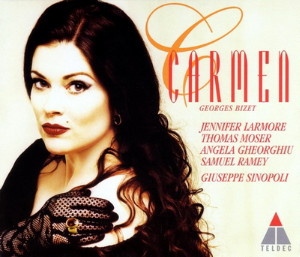
 |
|
DG - 3
CDs - 0630-12672-2 - (p) 1996
|
|
.jpg) |
| DG - 1
CD - 3984-21771-2 - (c) 1998 |
|
| Georges
BIZET (1838-1875) |
|
|
|
|
|
|
|
| Carmen |
|
158' 01" |
|
| Opéra Comique en
trois acte d'après la nouvelle
de Prosper Mérimée |
|
|
|
|
|
|
|
|
|
Compact Disc 1 |
|
53'
56" |
|
|
|
1.
Prélude |
3' 29" |
|
*
|
| PREMIER ACTE
|
N° 1:
Introduction: |
2.
"Sur la place chacun passe" (Les
soldats, Moralès)
|
2' 02"
|
|
|
|
|
3. "Regardez donc
cette petite" (Moralès, Les
soldats, Micaëla) |
4' 03" |
|
|
|
N° 2: Marche et
Choeur des gamins:
|
4.
"Avec la garde montante" [Mélodrame]
(Choeur des gamins) |
2' 21"
|
|
|
|
|
5.
"Halte! Repos!" (Zuniga,
Moralès, Don José) |
0' 53" |
|
|
|
|
6.
"Et la garde descendante" (Choeur des
gamins) |
1' 28"
|
|
|
|
|
7.
"Dites-moi, brigadier" (Zuniga,
Don José) |
0' 41" |
|
|
|
N° 3: Choeur et
Scène: |
8.
"Voici la cloche qui sonne" / "La
cloche a sonné" (Don José, Les
jeunes gens, Les soldats, Les
cigarières) |
2' 26" |
|
* |
|
|
9.
"Dans l'air, nuos suivons la fumée"
(Les cigarières, Les jeunes gens) |
2' 50" |
|
* |
|
|
10.
"Mais nous ne voyons pas la
carmencita" (Les Soldats, Les
jeunes gens) |
0' 41" |
|
|
|
|
11.
"Quand je vous aimerai?" (Carmen) |
0' 26" |
|
|
|
N° 4: Havanaise: |
12.
"L'amour est un oiseau rebelle" (Carmen,
Choeur) |
4' 21" |
|
* |
|
N° 5: Scène |
13.
"Carmen! sur tes pas nous nous
pressons tous" (Les jeunes gens,
Les cigarières) |
2' 05" |
|
|
|
|
14.
"Quelle effronterie!" (Don José,
Micaëla) |
0' 17" |
|
|
|
N° 6: Duo |
15.
"Parle-moi de ma mère!" (Don
José, Micaëla) |
1' 30" |
|
* |
|
|
16.
"Votre mère avec moi sortait de la
chapelle" (Micaëla, Don
José) |
2' 15" |
|
* |
|
|
17.
"Ma mère, je la vois!" (Don
José, Micaëla) |
1' 01" |
|
* |
|
|
18.
"Qui sait de quel démon j'allais
ȇtre la proie!" (Don José, Micaëla) |
4' 41" |
|
* |
|
|
19.
"Attends, je vais finir sa lettre" (Don
José, Micaëla) |
0' 33" |
|
|
|
N° 7: Choeur |
20.
"Au secours!" (Les cigarières,
Zuniga, Les soldats) |
4' 02" |
|
|
|
|
21.
"Maintenant que nous avons un peu de
silence" (Zuniga, Don José) |
0' 22" |
|
|
|
N° 8: Chanson et
Mélodrame |
22.
"Avez-vous quelque chose à répondre"
/ "Tra la la la..." (Zuniga,
Carmen) |
3' 33" |
|
|
|
|
23.
"Où me conduirez-vous?" (Carmen,
Don José) |
0' 53" |
|
|
|
N° 9: Chanson
[Séguedille] et Duo |
24.
"Près des remparts de Séville" (Carmen,
Don José) |
4' 35" |
|
* |
|
N° 10: Finale |
25.
"Voici l'ordre" (Zuniga, Carmen) |
2' 28" |
|
|
|
|
Compact Disc 2 |
|
43'
19" |
|
|
|
1.
Entracte |
1' 44" |
|
|
| DEUXIÈME
ACTE |
N° 11: Chanson: |
2.
"Les tringles des sistres tintaient"
(Carmen, Frasquita, Mercédès) |
5' 08" |
|
* |
|
|
3.
"Vous avez qualque chose à nous
dire" (Zuniga, Pastia, Mercédès,
Frasquita, Carmen) |
1' 03" |
|
|
|
N° 12: Choeur et
Ensemble:
|
4.
"Vivat! vivat le toréro!" (Choeur,
Zuniga, Mercédès, Andrès,
Frasquita, Pastia) |
1' 33" |
|
|
|
N° 13: Couplets
[Air du Toréador]: |
5.
"Votre toast, je peux vous le
rendre" (Escamillo, tous) |
4' 40" |
|
* |
|
|
6.
"Messieurs les officiers, je vous en
prie!" (Pastia, Zuniga,
Escamillo, Carmen) |
0' 53" |
|
|
|
N° 13bis: Choeur:
|
7.
"Toréador, en garde!" (Choeur) |
1' 07" |
|
* |
|
|
8.
"Pourquoi étais-tu si pressé" (Frasquita,
Pastia, Le Dancaïre, Mercédès, Le
Remendado) |
0' 35" |
|
|
|
N° 14: Quintette: |
9.
"Nous avons en tête une affaire" (Le
Dancaïre, Frasquita,
Mercédès, Le Remendado,
Carmen) |
4' 56" |
|
|
|
|
10.
"En voilà assez!" (Le
Dancaïre, Le
Remendado,
Frasquita,
Carmen,
Mercédès) |
0' 36" |
|
|
|
N° 15: Chanson: |
11.
"Halte-là! Qui va là?" (Don
José) |
0' 37" |
|
|
|
|
12.
"C'est un dragon, ma foi" (Mercédès,
Frasquita, Le
Dancaïre,
Carmen) |
0' 21" |
|
|
|
|
13.
"Halte-là! Qui va là?" (Don
José) |
0' 44" |
|
|
|
|
14.
"Enfin... te voilà" (Carmen, Don
José) |
0' 45" |
|
|
|
N° 16: Duo: |
15.
"Je vais danser en votre honneur"
[Air de la Fleur] (Carmen, Don
José) |
5' 55" |
|
|
|
|
16.
"La fleur que tu m'avais jetée" (Don
José, Carmen) |
3' 44" |
|
* |
|
|
17.
"Non! tu ne m'aimes pas!" (Carmen,
Don José) |
3' 46" |
|
* |
|
N° 17: Finale: |
18.
"Holà! Carmen! Holà, holà!" (Zuniga,
Don José, Carmen, Le Remendado, Le
Dancaïre, Les
bohémiens) |
3' 32" |
|
|
|
|
19.
"Suis-nous à travers la campagne" (Frasquita,
Mercédès, Carmen, Le Remendado, Le
Dancaïre, Les bohémiennes, Don
José) |
1' 42" |
|
|
|
|
Compact Disc 3 |
|
60'
46" |
|
|
|
1.
Entacte |
3' 18" |
|
|
|
|
Premier
Tableau
|
|
|
|
| TROISIÈME
ACTE
|
N° 18:
Introduction:
|
2.
"Ecoute, compagnon, écoute!" (Les
contrebandiers, Frasquita,
Mercédès, Carmen, Don José, Le
Dancaïre, Le
Remendado) |
4' 13" |
|
|
|
|
3.
"Reposons-nous une heure ici" (Le
Dancaïre, Don
José, Carmen) |
0' 51" |
|
|
|
N° 19: Trio:
|
4.
"Melons! Coupons!" (Frasquita,
Mercédès) |
3' 21" |
|
|
|
|
5.
"Carreau! Pique! ... La mort!" (Carmen) |
3' 03" |
|
* |
|
|
6.
"Parlez encore, parlez, mes belles"
(Frasquita, Mercédès, Carmen) |
0' 47" |
|
* |
|
|
7.
"Eh bien? ... nous avons aperçu" (Carmen,
Le
Dancaïre,
Mercédès, Le
Remendado,
Frasquita, Don
José) |
0' 29" |
|
|
|
N° 20: Morceau
d'Ensemble:
|
8.
"Quant au douanier, c'est notre affaire!"
(Frasquita, Mercédès, Carmen, Les
bohémiennes, Les bohémiens, Le
Dancaïre, Le Remendado) |
3' 07" |
|
* |
|
|
9.
"Ah, enfin, nous y sommes" (Le
guide, Micaëla) |
0' 19" |
|
|
|
N° 21: Air: |
10.
"Je dis que rien ne m'épouvante" (Micaëla) |
4' 59" |
|
* |
|
N° 22: Duo:
|
11.
"Qui êtes-vous? Répondez" - "Je suis
Escamillo, toréro de Grenade" (Don
José, Escamillo) |
5' 23" |
|
|
|
N° 23: Finale:
|
12.
"Holà! holà! José!" (Carmen,
Escamillo, Le Dancaïre, Don
José, Les contrebandières, Les
contrebandiers) |
2' 50" |
|
|
|
|
13.
"Halte! quelqu' un est là" (Le
Remendado, Carmen, Le Dancaïre, Don José, Micaëla,
Choeur) |
5' 52" |
|
|
|
|
14.
Entracte |
2' 14" |
|
* |
|
|
Deuxième
Tableau |
|
|
|
|
N° 24: Choeur:
|
15.
"A deux cuartos" (Les
marchandes, Les marchands, Zuniga,
Andrès, Un bohémien) |
2' 18" |
|
* |
|
|
16.
"Qu' avez-vous donc fait de la
Carmencita?" (Zuniga, Frasquita,
Andrès, Mercédès) |
0' 38" |
|
|
|
N° 25: Choeur et
Scène:
|
17.
"Les voici! Vinci la quadrille" (Les
enfants, choeur) |
3' 45" |
|
* |
|
|
18.
"Si tu m'aimes, Carmen" (Escamillo,
Carmen) |
1' 25" |
|
|
|
|
19.
"Place! place! au Seigneur Alcade!"
(Quatre Alguazils, Les enfants,
Choeur, Frasquita, Carmen,
Mercédès) |
2' 19" |
|
|
|
N° 26: Duo finale: |
20.
"C'est toi!" - "C'est moi!" (Carmen,
Don José) |
5' 42" |
|
* |
|
|
21.
"Viva! la course est belle!" (Choeur,
Don José, Carmen) |
3' 54" |
|
* |
|
|
|
|
|
|
| Jennifer LARMORE,
CARMEN, une bohémienne |
CHOR DER BAYERISCHEN
STAATSOPER |
|
| Thomas MOSER, DON
JOSÉ, un brigardier |
Udo Mehrpohl, Chorus
master |
|
| Angela GHEORGHIU,
MICAËLA, une jeune paysanne |
KINDERCHOR DER BAYERISCHEN STAATSOPER |
|
| Samuel RAMEY, ESCAMILLO,
un toréro |
Eduard Asimont, Chorus
master |
|
Nathalie BOISSY,
FRASQUITA, bohémienne
|
BAYERISCHES
STAATSORCHESTER |
|
| Natascha PETRINSKY,
MERCÉDÈS, bohémienne |
Giuseppe SINOPOLI |
|
| Maurizio MURARO,
ZUNIGA, un lieutenant |
Dialogue adaptation,
Language coach & musical assistant:
Janine Reiss |
|
| Jean-Luc CHAIGNAUD,
MORALÈS, un brigardier |
Musical coach: Donald
Wages |
|
| Jan ZINKLER, LE
DANCAÏRE, contrebandier |
|
|
| Ulrich REß, LE
REMENDADO, contrebandier |
|
|
| Gintares WYSNIAUSKAS,
ANDRÈS, un lieutenant |
|
|
| Ulrike UHLMANN,
UNE MARCHANDE |
|
|
| Dieter MISERRE,
UNE BOHÉMIEN |
|
|
| Nicolas TREES, LILLAS
PASTIA, le tenancier de taverne |
|
|
|
|
|
|
Luogo
e data di registrazione |
|
Stadthalle,
Germering (Germania) - dicembre
1995 |
|
|
Registrazione:
live / studio |
|
studio
|
|
|
Executive
producer
|
|
Renate
Kupfer |
|
|
Recording
producer |
|
Wolfgang
Stengel |
|
|
Recording
engineer |
|
Jens
Schünemann, Tobias Lehmann |
|
|
Digital editing |
|
Stefan
Witzel, Jens Schünemann |
|
|
Prima Edizione
LP |
|
-
|
|
|
Prima Edizione
CD |
|
Teldec |
0630-12672-2 | LC 6019 | 3 CDs -
53' 56". 43' 19" & 60' 46" |
(p) 1996 | DDD
Teldec
| 3984-21771-2 | LC 6019 | 1 CD -
76' 13" | (c) 1998 | DDD |
Highlights *
|
|
|
Note |
|
-
|
|
|
|
|
|
|
|
|
THE OPERA'S
GENESIS AND FIRST
PEFORMANCES
I have just been
ordered to compose three
acts for the Opéra Comique.
Meilhac and Halévy are doing
my piece" - so runs the
first brief reference to Carmen
in Bizet's
correspondence.Henri Meilhac
was also known as a
cartoonist, while Ludovic
Halévy had a full-time job
at the Ministry of the
Interior and in the Algeria
Office. Their other
collaborations include not
only Offenbach's La
belle Hélène and La
vie parisienne but
also the original scenario
for Johann Strauß’s Die
Fledermaus. They made
numerous changes to Mérimées
short story in an attempt to
tone down the character of
Carmen and make her more
suitable to the operatic
stage, turning the common
prostitute into a “normal”
woman, a transformation that
ultimately constituted a far
greater assault on society.
They invented the character
of Micaëla and, with her,
the idea of domestic
happiness, conceiving her as
the embodiment of chaste and
steadfast love and, as such,
a foil to Carmen. Although
the figure of Escamillo is
to be found in Mérimée, he
is no swaggeringly
successful bullfighter. The
librettists also added the
usual stock-in-trade of opéra
comique, including
street urchins, smugglers
and the chorus outside the
bullring. All these
characters are related to
their counterparts in
Offenbach's operettas, which
are likewise peopled with
smugglers and robbers,
soldiers and women of easy
virtue; only Bizet’s music
has invested them with
individuality. Like the
composer, Meilhac and Halévy
never visited Spain, but
they used a whole series of
authentic sources, chief of
which were contemporary
travelogues by writers such
as Théophile Gautier and
Alexandre Dumas père
and engravings by Gustave
Doré and others, all of
which served as concrete
models in drafting the
scenario and dialogue. Some
of the words, including
those of the Habanera, are
by Bizet himself.
Although Carmen
is now one of the most
widely performed of all
operas, its first
performance on 3 March 1875
was a flop. Halévy described
his impressions of the first
night in a hurried letter to
a friend written on the
morning after the
performance, allowing us to
recapture something of the
mood of that occasion:
"Act
I well received.
Galli-Marié's first song
applauded, also the duet
for Micaëla and José. End
of the act good -
applause, singers called
back on stage. A lot of
people on stage after this
act. Bizet surrounded and
congratulated. The second
act less fortunate. The
opening very brilliant.
Great effect from the
toreador's entry, followed
by coldness. From that
point on, as Bizet
deviated more and more
from traditional form of opéra
comique, the public
was surprised,
discountenanced perplexed.
Fewer people round Bizet
between the acts.
Congratulations less
sincere, embarrassed,
constrained. The coldness
more marked in the third
act [scene one]. The only
thing applauded was
Micaëla's air, of old
classical cut. Still fewer
people on stage. And after
the fourth act [third act,
scene two], which was
glacial from first to
last, no one at all except
three or four faithful and
sincere friends of
Bizet's. They all had
reassuring phrases on
their lips but sadness in
their eyes. Carmen
had failed."
The reasons fo
this failure were due as
much to the subject matter
as to the music. Even before
the first night, there had
already been criticism of
the allegedly "immortal"
action and its cast of
smugglers and cigarette
makers. Particular obloquy
was reserved for the final
scene, in which the heroine
is murdered on stage.
Moreover, Bizet himself was
the subject of immoderately
high and irreconcilable
expectations. It was said
that he would either restore
opéra comique to its
former glory or that he
would adopt a grand
Wagnerian manner. In the
event, he confounded both
these expectations by
picking up the tradition of
French opéra comique
and developing it by
combining it with social and
emotional realism. The
critics had a field-day,
accusing the composer of
immorality and claiming that
the score lacked order,
planning and clarity and
that the subject matter was
unsuited to the theatre.
None the less, the work had
already been performed no
fewer than thirtythree times
by the date of Bizet’s
sudden death on 3 June 1875,
the charge of immorality
merely serving to add to the
opera's appeal. Carmen
was given forty-eight times
during the 1875/76 season,
but then disappeared from
the Paris repertory for many
years, not returning to the
composer's native city until
its success had been assured
by a number of productions
abroad.
VERSIONS OF
THE OPERA
Carmen
belongs to the French opéra
comique tradition, in
which arias and ensembles
are interspersed with spoken
dialogue. (A similar feature
may be found in German
Singspiels such as Mozart's
Die Entführung aus dem
Serail and Die
Zauberflöte.) For the
first Viennese production of
the work in October 1875 (in
other words, after the
composer's death), Ernest
Guiraud, a friend of
Bizet's, replaced the spoken
dialogue with recitatives,
while at the same time
taking the opportunity to
cut portions of the text. He
also altered the
instrumentation and even
interpolated a ballet. His
recitatives reveal an
embryonic leitmotif
technique clearly designed
to turn the work into a grand
opéra and to transform
what had been a light opéra
comique, with its
relatively comic tone, into
an emotionally heavyweight grand
opéra. (A number of
Offenbach’s works are
likewise termed opéras
comiques.) Not until
1906 did Hans Gregor restore
the spoken dialogue for a
production in Berlin. Walter
Felsenstein's 1949
production was only one of
many attempts to provide a
new German translation of
the work, but even he had
difficulty establishing an
authentic version, since not
even the first French
printed edition of the vocal
score is identical in every
respect with Bizet's
autograph sources.
It was not until
much later that the
conducting score used at the
first performance was
rediscovered, revealing that
no fewer than 71 sides of
the score had been pasted
over or stitched together
while at the same time
enabling scholars to tell
which changes to the
instrumentation and
performance markings such as
tempo had been made by Bizet
himself and which had been
introduced subsequently.
Fritz Oeser’s “Critical New
Edition Based on All
Existing Sources” was
published in 1964 and
immediately caused an outcry
not least because other
musicologists placed a
different interpretation on
the sources. Moreover it is
now virtually impossible to
say which cuts and additions
were instigated by Bizet
himself, which were merely
concessions to particular
singers or to the
circumstances surrounding
the first production, and
which should be regarded as
being of lasting
significance.
For Giuseppe
Sinopoli, Fritz Oeser’s
great merit lies in his
“having had the courage
after all these years to
come up with a critical
edition based on Bizet's
original sources. My own
particular aim was to
perform everything just as
Bizet wanted it. All the
cuts that are so often
undertaken result in a piece
that is neither simpler nor
more beautiful nor more
logical than Bizet’s
original, but in reality
detract from it. What is
lost in this way are often
small details, nuances, a
slightly different
perspective or a brief
retrospective glance which
is, however of great
interest and dramaturgically
justified. Bizet's original
is a precise and implacable
dramatic run-through, the
result of a sincere desire
to reflect and brood on the
way in which a story like
Carmen's could come about.”
LOVE THAT ENDS
IN DISASTER
For all its
folklore and local colour, Carmen
is ultimately about the
conflict between two people
who love each other and in
doing so cause each other
pain and disillusionment - a
love, in short, that ends in
disaster. Carmen is
one of the first operas not
to include in its cast-list
any characters from the
upper echelons of society:
the conflicts are not due to
any social factors but stem
from an unavoidable clash of
emotions.
For José, Carmen
is a femme fatale,
he describes her as a witch,
a demon and even as a devil.
He thinks she has magic
powers. Whether or not this
view of Carmen is rooted in
superstition or in his
general fear of women, it
leads to his losing his
direction in life and
ultimately to his moral
collapse. José is afraid of
Carmen and of the force of
her femininity. And Carmen
certainly uses her sexuality
in a calculating way. But it
remains doubtful whether we
can really call her a femme
fatale. She does not
intentionally cause ]osé’s
downfall but defines her own
space and insists on her
freedom. Carmen is both
instigator and victim at one
and the same time. She is
introduced as an object of
male desire: she sings and
dances for men, is used by
Lillas Pastia to drum up
trade and helps the
smugglers by distracting
customs officers and
soldiers with her physical
charms. But she also tries
to break out of this role
and to protect herself from
men. Her Habanera is an
expression of her
philosophy: her love cannot
be obtained by threats or
cajolery. “If you don’t love
me, I love you, and if I
love you, beware!” The men
she wants are precisely
those who do not immediately
lust after her José
initially appears
unimpressed and, as such,
represents a challenge. Only
when he is so much in love
with her that he is willing
to suffer degradation and
imprisonment on her account
is she herself impressed.
But later he begins to bore
her and she drops him
without a moment's
hesitation, not least
because he is not prepared
to subordinate his duties as
a soldier to his love for
her. In the end Carmen
chooses death, literally
provoking José into killing
her.
In turn, José
expects too much of Carmen
with his insistence on
possessing her to the
exclusion of all else. He
fails to understand her true
nature. Don José is an
impoverished member of the
rural aristocracy who gives
the impression of being a
mother-fixated petty
bourgeois dreaming of
domestic bliss. He is
perfectly well aware that he
could find such happiness
with Micaëla, the submissive
and naïve country girl, but
makes no attempt to pursue
this line of least
resistance. The feelings
that draw him to Carmen -
first love, then hatred -
are stronger Walter
Felsenstein once described Carmen
as “a string of confused
relationships”:
Micaëla loves José, José
loves Carmen, Carmen loves
Escamillo, and Escamillo
loves no one but himself.
THE MUSIC
Carmen
is a typical opéra
comique, even if this
fact may have become
obscured as a result of
adaptations of the score
that have long been common
currency. Not even the
tragic dénouement in the
form of Carmen's murder is
at odds with this tradition:
the term opéra comique
has little to do with the
English word "comic" and
rather more to do with
Balzac's comédie humaine.
Moreover, there had been
examples of opéras
comiques with tragic
endings even before Bizet.
Typical of the genre is the
use of spoken dialogue
between the musical numbers,
and the realistic way in
which music is pressed into
service: the march of the
street urchins in Act One,
the Habanera, Seguidilla and
Carmen’s song in Act Two
with its castanet
accompaniment and trumpet
calls in the background are
all realistic numbers that
could equally well be found
as incidental music in a
play. Alongside these, there
are of course arias,
ensembles and choral
numbers, but astonishingly
few of them are typically
operatic in style. All,
moreover, are legitimised by
the action.
Music’s affinities
with dance add a further
dimension here: in Carmen,
music is often an expression
of the whole body, not just
of the voice. Even the
overture already
encapsulates the opera's
basic conflict, the music
associated with the
bullfight being offset by a
dramatic motif in D minor
that ends abruptly in
adissonance and that can be
regarded as expression of
Carmen's rebellious nature
and desire for freedom. In
the rest of the work, too,
lyrical and dramatic
elements are interwoven with
others of a more folklike
character. Yet all are
related to the action and
are never used for their own
sake. The choice of
particular leitmotifs, the
sophisticated use of dynamic
markings and the rhythmic
design of the piece are
likewise all subservient to
the overriding drama. Even
the Introduction to Act One
is a classic example of
Bizet's mastery in terms of
its basic mood and
appropriateness to the
action: beginning with a
musical portrait of the
strolling crowd, it almost
allows the listener to feel
the Spanish sun beating down
before introducing us to
Micaëla, who, initially
afraid, mischievously adopts
the soldiers’ teasing tone
before slipping away "like a
bird", her escape clearly
audible in the orchestra.
Carme's Seguidilla
is an example of a typically
Spanish dance, whereas the
habanera is Cuban in origin,
the flamenco of gypsy
provenance. With its
descending scale ending on
the dominant, the Fate motif
recalls Andalusian music, in
which oriental influence is
unmistakable. Yet Carmen
does not claim to be a
faithful musical portrait of
Spain. In Bizet`s day,
Spanish music was something
of a fashionable phenomenon
and, like Hungarian music,
was used by many composers
to add spice to their
musical language. One thinks
in this context of works
such as Glinka's Spanish
Overtures, Rimsky-Korsakov's
Capriccio espagnol,
Sarasate's Spanische
Tänze, Lalo’s Symphonie
espagnole, Chabrier's
España and Debussy’s
Ibéria. It was not
until much later that
composers such as Ravel
(himself half-Basque in
origin), Falla, Albéniz and
Granados wrote music with
which the Spanish themselves
could identify.
Andreas Richter
(Translation:
Stewart Spencer)
|
|
|