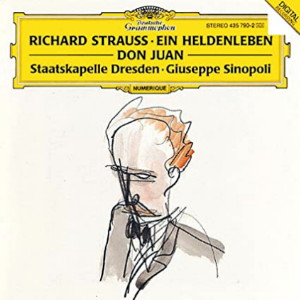
Strauss was only 24
when he completed Don Juan
in September 1888. The
composer’s first mature
masterwork, its maturity and
mastery seem the more
remarkable when it is compared
with the much more ordinary
music - Aus Italien, Macbeth
- that immediately preceded
it. His meeting with his
future wife, the singer
Pauline de Ahna, and the
special excitement he found in
Lenau’s unfinished verse
drama, quoted copiously at the
bead of the score, may, in
combination, explain the
sudden leap forward. Strauss
liberated himself from his
apprenticeship, not through
the embrace of musical
libertinism, but through the
imaginative adaptation of a
symphonic formal scheme, whose
outline owes much to Liszt but
whose musical language pushes
the earlier master firmly back
into history.
Don Juan’s life and death are
shaped by sonata form. Without
introduction, the first group
of themes present the
iconoclastic womanizer in all
his flamboyantly compelling
capriciousness. With the
change to more lyrical
material (the second group) we
hear for the first time the
power that love and beauty
exercise over him. There may
be an element of posturing to
his passion, and some sense
that this idealized, even
noble eroticism is more
fantasy than reality: but
there is no mistaking the fact
that. for Strauss. Don Juan
was far from a mere antihero.
With the onset of musical
development, this vision of
nobility is destabilized, and
the focus shifts from
conqueror to conquered. The
lover we meet is seductive
but, above all, submissive,
and the beautifully shaped
oboe melody creates the
fantasy that she might, after
all, be his one true love.
Juan responds heroically, as a
powerful, warm-hearted theme
is projected by the four horns
in unison. Yet this very
power, suggesting a depth of
sincere experience which he
cannot sustain, drives him
back into a brittle
dream-world. In the symphonic
recapitulation, Don Juan is
brought back to the essential
materials of his character,
and to the impossibility of
achieving stability through
harmonizing the warring facets
of his psyche. The solution,
as the Coda graphically
reveals, is self-destruction.
In Lenau, Juan fights a duel,
has the challenger at his
mercy, but allows himself to
be killed. The musical ending
is terse, unsparing and, for
this very reason, serves to
sustain something of the
abiding myth of heroism that
attaches to this archetypal
figure.
Strauss himself wrote of Ein
Heldenleben with
characteristic humour: “As
Beethoven’s Eroica is
so very unpopular with our
conductors and therefore is
seldom performed nowadays, I
am composing a great tone poem
entitled Heldenleben.
True, it has no funeral march,
but it is in E flat major and
has lots of horns”. The irony
was enhanced when, on the very
day in 1898 that the main
draft was finished, Strauss
noted in his diary: “the great
Bismarck dismissed”. Heldenleben
is certainly not “about”
Bismarck. Yet it is a portrait
of the strengths and
weaknesses of a personality
embodied in the social,
cultural aspirations of a
Germany dominated by
successful public figures like
Bismarck, and like Strauss
himself.
Like Don Juan, but on
a much larger scale, Heldenleben
has the framework of a single
sonata movement. The first
subject group ("The Hero”, to
use the section titles which
the composer never disowned)
characterizes the protagonists
essential nobility of spirit.
There is a touch of
loquaciousness, at least in
comparison with Juan, but this
is still an unmistakably
charismatic personality. It is
the ensuing transition (‘”The
Hero’s Adversaries“),
depicting small-minded
chatterers, which gives the
clearest indication that the
hero is an artist, and his
adversaries critics. Such
material is ideally framed to
offset the hero`s own
open-hearted lyricism and the
volatile romanticism of the
subsequent second-subject
group (“The Hero's
Companion”). Here,
autobiography is explicit, and
Strauss confessed that he
intended a portrait of
Pauline. The love music is
ardent, with the solo violin
representing the beloved, and
the sheer richness of texture
and subtlety of orchestration
reveal the composer at his
most resourceful.
The
expansive development depicts
"The Hero’s Deeds of War”.
This is engaging,
whole-hearted fantasy, more
exuberant ego-trip than
serious megalomania, and the
hero’s battle for artistic and
erotic supremacy reaches its
apogee with a thrilling
quotation of the great horn
theme from Don Juan.
As we move from "Deeds of War”
to “Works of Peace”
(Recapitulation) the
autobiographical dimension
intensifies again, and a wide
range of self-quotation is
worked into the fabric, mainly
from the earlier tone poems,
but also from the opera Guntram
and a couple of songs. All
this creative rethinking
produces a crisis, and the
hero finds ultimate fulfilment
in retirement from the world
of action. The Coda depicts a
life of tranquil contemplation
in which even the memories of
earlier conflicts that surface
seem unreal. Strauss
originally underlined this
mood by giving the work a
sustainedly quiet ending, but
he soon changed his mind to
provide the more assertive
final gesture We now hear.