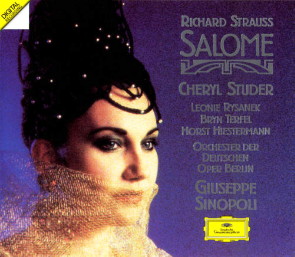
 |
|
DG - 2
CDs - 431 810-2 - (p) 1991
|
|
| Richard
STRAUSS (1864-1949) |
|
|
|
|
|
|
|
| Salome |
|
101' 46" |
|
| Musikdrama in
einem Aufzug nach Oscar Wildes
gleichnamiger Dichtung (Deutsch
von Hedwig Lachmann) |
|
|
|
|
|
|
|
|
Compact Disc 1 |
|
56'
28" |
|
ERSTE
SZENE
|
1.
"Wie schön ist die Prinzessin salome
heute nacht!" |
2' 43" |
|
|
|
2.
"Nach mir wird Einer Kommen" |
2' 28"
|
|
|
ZWEITE
SZENE
|
3. "Ich will nicht
bleiben. Ich kann nicht bleiben" |
1' 42" |
|
|
|
4.
"Siehe, der Herr ist gekommen" |
1' 36"
|
|
|
|
5.
"Jauchze nicht, du Land Palästina" |
4' 13" |
|
|
|
6.
"Laßt den Propheten herauskommen" |
2' 19"
|
|
|
| DRITTE SZENE
|
7.
"Wo ist er, dessen Sündenbecher
jetzt voll ist?" |
4' 34" |
|
|
|
8.
"Er ist schrecklich. Er ist wirklich
schrecklich!" |
2' 02" |
|
|
|
9.
"Wer ist dies, Weib, das mich
ansieht?" |
2' 33" |
|
|
|
10.
"Jochanaan! Ich bin verliebt in
deinen Leib!" |
2' 18" |
|
|
|
11.
"Dein Leib ist grauenvoll" |
2' 27" |
|
|
|
12.
"Zurück, Tochter Sodoms! Berühre
mich nicht!" |
2' 44" |
|
|
|
13.
"Niemals. Tochter Babylons, Tochter
Sodoms, ... Niemals!" |
1' 12" |
|
|
|
14.
"Word dir nicht bange, Tochter der
Herodias?" |
2' 57" |
|
|
|
15.
"Laß mich deinen Mund küssen,
Jochanaan" |
1' 00" |
|
|
|
16.
"Du bist verflucht" |
5' 08" |
|
|
| VIERTE SZENE
|
17.
"Wo ist Salome? Wo ist die
Prinzessin?" |
3' 28" |
|
|
|
18.
"Salome, komm, trink Wein mit mir" |
2' 44" |
|
|
|
19.
"Sieh, die Zeit ist gekommen" |
0' 53" |
|
|
|
20.
"Wahrhaftig, Herr, es wäre besser,
ihn in unsre Hände zu geben" |
0' 53" |
|
|
|
21.
"Siehe, der Tag ist nahe, der Tag
des Herrn" |
2' 36" |
|
|
|
22.
"O über dieses geile Weib, die
Tochter Babylons" |
2' 27" |
|
|
|
Compact Disc 2 |
|
45'
18" |
|
|
1.
"Tanz für mich, Salome" |
4' 04" |
|
|
|
2.
"Salomes Tanz der sieben Schleier" |
9' 28" |
|
|
|
3.
"Ah! Herrlich! Wundervoll,
wundervoll!" |
4' 20" |
|
|
|
4.
"Salome, ich beschwöre dich" |
3' 14" |
|
|
|
5.
"Salome, bedenk, was du tun willst" |
2' 49" |
|
|
|
6.
"Gib mir den Kopf des Jochanaan!" |
1' 50" |
|
|
|
7.
"Es ist kein Laut zu vernehmen" |
2' 21" |
|
|
|
8.
"Ah! Du wolltest mich nicht deinen
Mund küssen lassen, Jochanaan" |
11' 19" |
|
|
|
9.
"Sie ist ein Ungeheur, deine
Tochter" |
1' 18" |
|
|
|
10.
"Ah! Ich habe deinen Mund geküßt,
Jochanaan" |
4' 36" |
|
|
|
|
|
|
|
| Horst HIESTERMANN,
HERODES, Tetrarch von Judäa |
ORCHESTER DER
DEUTSCHEN OPER BERLIN |
|
| Leonie RYSANEK,
HERODIAS, Gemahlin des Tetrarchen |
Giuseppe SINOPOLI |
|
| Cheryl STUDER, SALOME,
Tochter der Herodias |
Musical assistance:
Patrick Walliser |
|
| Bryn TERFEL, JOCHANAAN,
der Prophet (Johannes der Täufer) |
|
|
| Clemens BIEBER,
NARRABOTH, der junge Syrier, Hauptmann
der Wache |
|
|
| Marianne RØRHOLM,
DER PAGE DER HERODIAS |
|
|
| Uwe PEPER, ERSTER
JUDE |
|
|
| Karl-Ernst MERCKER,
ZWEITER JUDE |
|
|
| Peter MAUS, DRITTER
JUDE |
|
|
| Warren MOK, VIERTER
JUDE |
|
|
| Manfred RÖHRL, FÜNFTER
JUDE |
|
|
| Friedrich MOLSBERGER,
ERSTER NAZARENER |
|
|
| Ralf LUKAS, UWEITER
NAZARENER |
|
|
| William MURRAY,
ERSTER SOLDAT |
|
|
| Bengt RUNDGREN,
ZWEITER SOLDAT |
|
|
| Klaus LANG, EIN
KAPPADOZIER |
|
|
| Aimée WILLIS, EIN
SKLAVE |
|
|
|
|
|
|
Luogo
e data di registrazione |
|
Jesus-Christus-Kirche,
Berlin (Germania) - dicembre 1990 |
|
|
Registrazione:
live / studio |
|
studio
|
|
|
Produced by |
|
Wolfgang
Stengel |
|
|
Co-Producer |
|
Pål
Christian Moe |
|
|
Balance
Engineer |
|
Klaus
Hiemann |
|
|
Publishers |
|
Fürstner
GmbH, Mainz, vertreten durch den
Verlag B. Schott's Söhne, Mainz |
|
|
Prima Edizione
LP |
|
- |
|
|
Prima Edizione
CD |
|
Deutsche
Grammophon | 431 810-2 | LC 0173
| 2 CDs - 56' 28" & 45' 18"
| (p) 1991 | DDD |
|
|
Note |
|
-
|
|
|
|
|
|
|
|
|
Strauss, Wilde
and "Salome"
Neither the
literary nor the musical worldhas quite known what
to make of the Salome of
Oscar Wilde and Richard Strauss. Although he
considered it “a specious second-hand work”, Mario
Praz accurately caught the ambivalence of
Wilde’s play in noting that the “childish prattle
employed by the characters” seems, perhaps
unintentionally, to reduce decadence to parody or
“the level of a nursery tale”. That Wilde’s Salomé
may be the forerunner, according to
Richard Ellmann, of the plays of Beckett and
Yeats presents a problem for critics, since
the historical importance and technical virtuosity
of both play and opera have never seemed adequate
to overcome the supposed depravity in
Wilde and the alleged banality of Strauss’s
musical material. The situation has merely been
rendered more confused by the discrepancy between
the opera’s immediate popularity with
audiences from its first performance in Dresden on 9
December 1905 and the warnings of moral
corruption which issued from authorities after the
Lord Chamberlain banned the play in 1892, the
year of its completion. The cast which opposed
play and opera in two continents had an element
of the comical; any group which united English
censorship, Kaiser Wilhelm II, Archbishop
Piffl of Vienna and J. P. Morgan in moral
outrage already contained within itself the
seeds of ridicule; the
difficulties which Strauss
experienced in having the work staged in Vienna or
New York were ultimately minor obstacles to
its triumphant progress. But the more considered
charges aimed against Wilde and Strauss by
serious critics, analysts and aestheticians
have fully balanced the often lavish praise
bestowed upon the opera by Strauss’s fellow
professionals such as Schoenberg, Mahler,
Busoni and a galaxy of French
contemporaries. As the subject
matter of
Salome has lost its power
to shock, critics of the opera have tended
to discern kitsch rather than immorality
beneath the dazzling surface of Strauss’s music,
though it has never been easy to decide what portion
of the blame for this may be laid at the
composer’s door. Behind this
lurks the
awkward question whether the
operatic
Salome should be seen as
anything more than a musical extension of
Wilde’s creation.
From play in prose to Literaturoper
Salome’s
historical significance
resides in large measure in
the way it marks an important
stage (alongside Debussy’s Pelléas
et Mélisande and the
underrated Ariane et
Barbe-Bleue of Dukas) in
the evolution of
post-Wagnerian music drama
into what German critics have
termed Literatur-oper.
The most obvious sign of this
is the means by which Strauss
solved the problem of finding
a librettist, by setting
Hedwig Lachmann’s translation
as it stood (albeit with very
substantial cuts); opera's
traditional verse, which even
Italian verismo lacked
the nerve or inclination to
discard, was rejected in
favour of prose. The prose
libretto thus entered the
opera house not in the service
of realism but in the guise of
the symbolism of Maeterlinck
and the “poetic” childishness
of Wilde. That Wilde wrote his
play in French, partly under
the influence of Flaubert,
Mallarmé and their treatments
of the Herodias story, helps
to stress the extent to which
Strauss responded to a
modernist, international
aesthetic (a point not lost on
certain critics of a more
narrowly nationalist bent);
when he saw Lachmann’s
translation on stage in 1902,
it was in Max Reinhardt’s
Kleines Theater, a forum for
modern theatre that already
looked forward to the more
experimental techniques of
Expressionism. It was on this
occasion that the cellist
Heinrich Grünfeld suggested
the possibility of an opera,
to which Strauss replied that
he was already composing it;
the play had been sent to him
in 1901 by the Viennese poet
Anton Lindner, who also made
some attempts to versify
Lachmann’s translation as the
traditional kind of libretto.
But after that Strauss
responded simply to Lachmann’s
opening sentence, “Wie schön
ist die Prinzessin Salome
heute nacht!” (possibly as
late as July 1903), and began
to compose, while at the same
time purging the play of many
“purple passages”, of which he
had no need, having possessed
a facility with purely
orchestral “purple passages”
since Don Juan.
The implications of Strauss`s
decision to create an opera
from a play in prose were
diverse. Already in Wagner,
the relationship between word
and music had been
reinterpreted, ostensibly in
favour of a literary and
psychological approach to
opera that stood apart from
both the older operatic
aesthetic and the “critical”
approach of present-day
developments (which accord
more with the central role
allotted to a director than
Wagner would probably have
appreciated). In Salome,
the drama is Wilde’s to the
extent that the music reflects
the text. In this critics have
seen problems which go beyond
Strauss’s opera. Wilde’s play
is not easily translated, as
the problems of its English
version make plain; this is
not simply a matter of the
“schoolboy faults” of Lord
Alfred Douglas in attempting
the first translation, but
rather a question of
reproducing the “music” of the
French original (which Wilde
in De profundis
insisted upon when criticizing
Douglas’s misguided efforts).
It is arguable that Lachmann
failed similarly, though the
further argument of some
writers that the German
language was in itself an
inappropriate vehicle for
Wilde’s kind of word-music
seems foolish in view of the
quality of the lyrics (often
French-inspired) which were
being created at the time by
Hofmannsthal, George and
Rilke. The role of Lachmann,
who moved in anarchist circles
both from her own convictions
and from those of her
poet-husband Gustav Landauer
(later murdered for his part
in the Bavarian Soviet of
1919), serves as a reminder
not of the “music” of the
original but rather that the
“musicality” of Wilde was
contemporary with his
alignment of the cult of the
aesthetically beautiful and a
form of libertarianism in The
Soul of Man under Socialism.
But a central problem of the
metamorphosis of Salome from
dramatic to operatic heroine
was the extent to which verbal
music in Wilde’s sense was
compatible with real musical
values. At the heart of
Strauss’s creative achievement
lies the paradox of a literary
work - itself characterized by
the rejection of realism in
favour of verbal incantation -
subjected to a musico-dramatic
treatment that seemed to
reflect a modern blend of
realism and psychology. While
Wilde’s Salomé
“aspired to the condition of
music”, Strauss’s Salome
aspired to the condition of
literary drama.
Leitmotif in Salome
For Strauss the play was the
starting-point, inasmuch as he
wrote down many of his initial
motivic ideas into a copy of
the German text so as to
suggest various correlations.
But the composition of the
work (which was finished, with
the notorious exception of the
Dance of the Seven Veils, by
20 June 1905) qualifies this
in ways which are not
unfamiliar from Wagner. The
efforts of Wagner scholars
have heavily modified the
traditional picture of the
leitmotif; it is no longer
sufficient to explain music
drama with a guidebook of
representation motives. This
was always apparent in the
case of Tristan and Isolde,
the Wagnerian music drama
which Salome most
resembles. Just as Wagner in Tristan
avoided literalness in the
complexity of his treatment of
the musical motive, so Strauss
in Salome evolved a
technique of transformations
of context that is often more
remarkable than the variations
of musical shape. Thus many
figures in Salome make
a fetish out of the interval
of a third, sometimes major,
more often minor. Similar
figures in the later Elektra
stand fairly unambiguously for
the murdered Agamemnon, But in
Salome many of these
ideas resist definition and
lead to subtle connections;
the major-third motive to
which Salome sings “Ich bin
verliebt in deinen Leib,
Jochanaan!” later sinks into
the minor, adding both force
and atmosphere in various
timbres to the execution of
the Baptist, Herod’s sense of
disgust, and the final
crushing of Salome beneath the
soldiers’ shields.
The path to this brutalization
of an originally shimmering
motive lies in the various
other motives which begin with
a minor third, notably “Ich
will deinen Mund küssen,
Jochanaan” and the figure to
which Salome repeatedly
demands the head of the
Baptist. Yet it is a sign of
the indirection with which
Strauss treats the
musico-dramatic motive that
neither of these sentiments
first enters in conjunction
with its characteristic
musical shape. Verbal and
musical motives find one
another as Salome’s obsession
grows. Her music when
demanding the head of
Jochanaan is presented in
almost incoherent dynamic
contrasts, the first
disorganized dawnings of
revenge as she crouches over
the cistern in which Jochanaan
is imprisoned. The demand
itself is presented as a
laughing throwaway, the
accompanying musical texture
of harp, celesta and clarinet
trill seeming to belong to the
laugh, or to the silver
salver, rather than to
Jochanaan’s head and its
imminent fate. It is only as
the dramatic conflict between
the beseeching Tetrarch and
Salome degenerates into
obduracy that the words “Ich
fordre den Kopf des Jochanaan”
move close to the musical
shape for which they were
seemingly predestined. By such
means Strauss keeps a fairly
primitive musical idea in a
state of flux. Even then,
however, he does not lose
sight of earlier stages in the
process, and the return of the
original major motive of
Salome’s infatuation in the
final monologue after the
climax at “Jochanaan, du warst
schön” turns the shimmer of
the motive into a texture of
celesta, harps and strings
whose liquidity is all the
more remarkable for the
immobility of the supporting
harmony; at such a moment it
is hard not to think ahead to
the silver rose in Der
Rosenkavalier.
The famous motive of two
fourths which at first stands
for certain aspects of
Jochanaan, is another instance
of a musical figure which
develops into something other
than a mere calling-card.
Ultimately it seems to evoke
the “geheimnisvolle Musik”
which Salome heard on seeing
Jochanaan. Yet by presenting
fragments of the motive before
Jochanaan appears, Strauss
suggests that Salome had been
ready for such “secret music”
before she fixed her obsession
upon the prophet. The musical
motive represents something
inchoate in this case, an
approximation to that almost
impossible intangibility which
earlier German Romantic
writers had felt to be at once
music’s true property and
goal. The two fourths of this
motive (which Schoenberg
bracketed with advanced
progressions in Mahler,
Debussy and Dukas) represent a
more radical novelty than the
chromatic sideslips of
Salome’s waltz-like entrance
theme; taken together, the two
types of ideas seem to
represent a world of
glittering surfaces and a
deeper reality lying
underneath. Salome’s tragedy
would seem to be that she
senses the reality but reaches
out to grasp it in a way that
is apparently superficial.
Here is one significant
tension between Strauss and
Wilde, since the love of
surfaces, the exaltation of
the aesthetic sensation, was
one of Wilde’s positives. What
is actually offered to Salome
by Jochanaan is a vision of
Christ on the Sea of Galilee
that is at once portentous in
its announcement, bland in its
harmony and insipid in its
melodic line; this Galilean is
pale indeed. Granted that
Strauss knew his Nietzsche and
had renounced conventional
religion, it is hard to avoid
the suspicion that the music
for Jochanaan and the
Nazarenes is not so much the
failure to which critics have
repeatedly referred but a
barely concealed contempt. The
secret music of Salome’s
imagination is of a complexity
that Jochanaan cannot fathom
and that Wilde’s fails to do
more than name; the true
climax of Jochanaan’s dialogue
with Salome is not to be found
in the outpourings of
Strauss’s orchestra (which
reaches new heights of frenzy
even for him, as the Baptist
retreats into the cistern
cursing his antagonist) but in
the “toneless shudder” of
“Niemals, Tochter Babylons,
Tochter Sodoms,... Niemals!”
Man’s potential fear of the
sensually aroused woman was
never more numbingly evoked.
The silence does not last
long. Later, however, Salome
does kiss Jochanaan’s head in
a prolonged silence broken
only by the soft swelling of a
directionless sonority of
nauseous intensity; at such
moments the childish
repetitions and banalities of
Wilde’s play find a reflex
commentary in Strauss’s
orchestra.
The sensuous façade
Conventionally such moments in
Strauss are classed as aspects
of his gift for illustration.
The orchestration of Salome
affords numerous examples of
pictorial detail, notably in
the scenes of violence, where
for many critics a new depth
of tastelessness was plumbed
by the use of short stabbing
strokes on high double basses
for the heroine’s irregular
breathing while the execution
is being carried out in the
cistern. Salome abounds
in such novelties. But the
orchestral and harmonic daring
are only one aspect of the
sensuous façade of the opera.
Salome is a testament
to the abundance of Strauss’s
melodic gifts as well as to
his illustrative facility, The
type of melody with which
Strauss operates is often
rather more traditional (or
banal, as harsher critics have
insisted) than his fame as
Wagner’s successor would
suggest. The musical motives
are frequently shaped into
relatively conventional
periods, and this is
particularly apparent in the
final monologue. It was Ernest
Newman’s belief that the music
for this monologue was
composed before earlier
sections based on the same
themes (such as the dialogue
between Salome and Jochanaan),
a view that probably
influenced Norman Del Mar when
he maintained that only with
the final monologue do words
and music seem to fit in the
most natural way. The unproven
theory might be crudely stated
in sonata terms: the “reprise”
was composed before the
“exposition”.
The sonata or symphonic
parallel was quickly pressed
into service to explain
Strauss’s technique and
structure in Salome.
Fauré’s comment is the most
famous, but also the most
glib: “Salome is a
symphonic poem with additional
voice parts”. Strauss’s
attitude to such comments was
equivocal; he recognized that
“unsuspecting critics” viewed
Salome (like Elektra)
as a“symphony with
accompanying voice parts”, but
felt that they did not
understand the extent to which
the symphonic organization
“conveyed the kernel of the
dramatic content”. That a
symphonic intelligence might
serve to shape music drama had
been recognized earlier by
Nietzsche in Richard
Wagner in Bayreuth, a
judgement that had passed into
the small talk of musical
criticism by Strauss’s day.
But Strauss had his own view
of the symphonic.
A page of reflections found
among the sketches for Also
sprach Zarathustra makes
quite clear that his idea of
the symphonic was not
dependent upon the kind of
thematic and motivic
development familiar in the
symphony of the 19th century;
the “briefest intimations” of
formal conflicts seemed to him
preferable to excessive
development of the type found
in Liszt. As a result, the
individual sections of much of
Strauss’s music seem more
elegantly formed than the
overall structure. He refused
to worry (as Mahler did) that
the “Dance of the Seven Veils”
would suffer for being
stitched together after the
composition of the rest of the
work. The periodic structures
of Salome’s monologue and
other sections enhance the
sensation of a sequence of
beautifully formed episodes;
if the work seems to have a
larger coherence, it may
simply be because the most
finished episodes come towards
the end. Even the conclusion
is a sudden interruption: the
final cadence of Salome’s
ecstatic kissing of the
severed head is cut short by
Herod’s capricious decision to
have her killed. As a result
the tonal scheme, which in
reality makes carefully
planned use of areas relating
to C and C sharp, seems no
less capricious. In such a
context, “symphonic” is a word
which can only be used in
relation to Strauss’s own very
idiosyncratic interpretation,
with which such contemporaries
as Mahler and Sibelius would
hardly have agreed. Forms are
as much part of the surface as
orchestration and waltz
rhythms.
The most striking aspect of Salome’s
episodic façade is the manner
in which Strauss turns the
five squabbling Jews into a
virtuoso scherzo, which he
described on a later occasion
as “pure atonality”; this
seems calculated to add
another dimension to the
general sense of scandal and
perversity which worried the
cast of Ernst von Schuch’s
Dresden company during
rehearsals. Sander L. Gilman
has pointed to the way in
which Strauss’s evocation of
Biblical Jews reads Wilde’s
text in a contemporary spirit,
thereby “subversively
contravening one of the basic
tenets of German
anti-Semitism, which saw the
Jews of the Bible, especially
of the New Testament, as
different from contemporary
Jewry.” According to Gilman’s
very subtle argument,
Strauss’s liberal Jewish
audience may have recognized
the despised “Eastern” Jews
from the ghettos in the
high-pitched hysterical
quintet, where
character-tenors of the same
kind as Herod outnumber a
solitary bass. An array of
stereotypes dominates Herod’s
court: stage Jews, Nazarenes
who sing in that pious
diatonicism which 19th-century
opera thought suitable to
religion, and the dancing
Salome, whose mild exoticisms
are all too easily (if
mistakenly) choreographed as a
lascivious strip-tease. The
sequence between Jochanaan’s
cursing of Salome and her
demand for his head is a diverlissement
of grotesques, a
representation of kitsch which
can hardly help being kitsch
itself, albeit of a
technically superior kind.
Whereas the pretension in
Wilde resides in the claim of
his childish sentences to
being musical, Strauss
exhibits the superficiality of
his characters by dwelling on
musical and dramatic clichés
swollen to pretension by the
amplifying voice of his
orchestra. There are
inevitably points of aesthetic
contact between Wilde and
Strauss, but as a whole Salome
demonstrates the problems
inherent in composing an opera
to a text which itself aspires
to music. The play is as
curiously innocent in its
presentation of hysteria,
obsession and cruelty as
Maeterlinck’s Pelléas et
Mélisande; whereas
Debussy strove to capture the
innocence as well as the
cruelty, Strauss took a more
robust interest in uncovering
the psychology of characters
who are infected by the
cruelty of the theme. As a
result, his opera leaves Wilde
far behind in intensity, while
retaining a consuming interest
in the nature of the surfaces
that lend even to the
hysterical and depraved an
aesthetic glamour.
|
|
|