 |
|
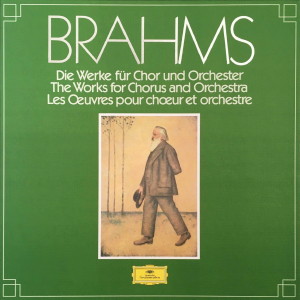
DG - 4
LPs - 2741 019 - (p) 1983
|
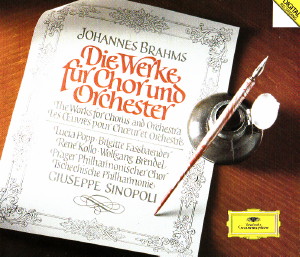 |
| DG - 3
CDs - 419 737-2 - (p) 1983 |
|
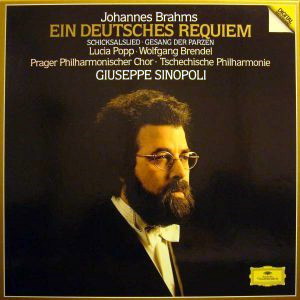 |
| DG - 2
LPs - 410 697-1 - (p) 1983 |
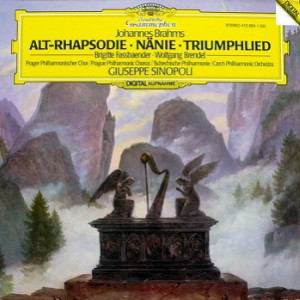 |
| DG - 1
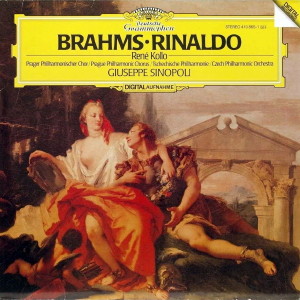
LP - 410 864-1 - (p) 1983 |
 |
| DG - 1
LP - 410 865-1 - (p) 1983 |
|
| Johannes BRAHMS
(1833-1897) |
|
|
|
|
|
|
|
Long Playing 1
|
|
52'
25" |
|
| Ein deutsches
Requiem, Op. 45 |
|
75' 40" |
|
| Nach Worten der
Heiligen Schrift für Soli, Chor
und Orchester |
|
|
|
| -
1. "Selig sind, die da Leid tragen"
- Ziemlich langsam und mit Ausdruck
(Chor) |
12' 13" |
|
|
| -
2. "Denn alles Fleisch, es istwie
Gras" - Langsam, marschmäßig · Un
poco sostenuto · Allegro non troppo
(Chor) |
15' 35" |
|
|
| -
3. "Herr, lehre doch mich" - Andante
moderato (Bariton und Chor) |
10' 24" |
|
|
| -
4. "Wie lieblich sind Deine
Wohnungen" - Mäßig bewegt (Chor) |
7' 24" |
|
|
| -
5. "Ihr habt nun Traurogkeit" -
Langsam (Sopran und Chor) |
6' 49" |
|
|
| Long Playing 2 |
|
47'
12" |
|
| -
6. "Denn wir haben hie keine
bleibende Statt" - Andante · Vivace
· Allegro (Bariton und Chor) |
10' 49" |
|
|
| -
7. "Selig sind die Toten" -
Feierlich (Chor) |
12' 38" |
|
|
| Triumphlied,
Op. 55 |
|
23' 45" |
|
| Offenb. Joh.
Kap. 19 - für achtstimmiger Chor
und Orchester |
|
|
|
| -
1. "Hallelujah! Heil und Preis" -
Lebhaft, feierlich (Chor) |
7' 31" |
|
|
| -
2. "Lobet unsern Gott, alle seine
Knechte" - Mäßig belebt · Lebhaft ·
Ziemlich langsam, doch nicht
schleppend (Chor) |
8' 21" |
|
|
| -
3. "Und ich sahe den Himmel
aufgetan" - Lebhaft · Feierlich
(Bariton und Chor) |
7' 43" |
|
|
| Long Playing 3 |
|
38'
50" |
|
| Rinaldo,
Op. 50 |
|
38' 50" |
|
| Kantate von
Johann Wolfgang von Goethe für
Tenor Solo, Männerchor und
Orchester |
|
|
|
| -
1. "Zu dem Strande! Zu der Barke"
(Allegro-Poco Adagio-Un poco
Allegretto-Moderato-Allegro-Allegro
non troppo-Poco sostenuto) |
22' 37" |
|
|
| -
2. "Zurück nur! zurücke" (Allegretto
non troppo-Andante con moto e poco
agitato-Allegro con fuoco-Andante) |
10' 09" |
|
|
| -
3. Schlußchor: "Segel schwellen"
(Allegro-Un poco tranquillo-Vivace
non troppo) |
6' 00" |
|
|
| Long Playing 4 |
|
53'
51" |
|
| Alt-Rhapsodie,
Op. 53 |
|
14' 21" |
|
Fragment
aus Goethes "Harzreise im Winter"
für Alt, Männerchor und Orchester
|
|
|
|
| -
"Aber abseits wer ist's?"
(Adagio-Poco Andante-Adagio) |
14' 21" |
|
|
| Nänie,
Op. 82 |
|
14' 12" |
|
| von Friedrich
von Schiller für Chor und
Orchester |
|
|
|
| -
"Auch das Schöne muß sterben!"
(Andante-Più sostenuto-Tempo primo) |
14' 12" |
|
|
| Schicksalslied,
Op. 54 |
|
16' 35" |
|
| von Friedrich
Hölderlin für Chor und Orchester |
|
|
|
| -
"Ihr wandelt droben im Licht"
(Langsam und
sehnsuchtsvoll-Allegro-Adagio) |
16' 35" |
|
|
| Gesang
der Parzen, Op. 89 |
|
8' 43" |
|
| von Johann
Wolfgang von Goethe für
sechstimmigen Chor und Orchester |
|
|
|
| -
"Er fürchte die Götter das
Menschengeschlecht!" (Maestoso) |
8' 43" |
|
|
|
|
|
|
| Lucia POPP, Sopran
(Op. 45) |
PRAGER
PHILHARMONISCHER CHOR |
|
| Wolfgang BRENDEL,
Bariton (Opp. 45 & 55) |
Lubomir Matl, Chorus
master |
|
| Brigitte FASSBANDER,
Alt (Op. 53) |
TSCHECHISCHE
PHILHARMONIC |
|
| René KOLLO, Tenor
(Op. 50) |
Giuseppe SINOPOLI |
|
|
|
|
|
Luogo
e data di registrazione |
|
Rudolfinum,
Praga (Cecoslovacchia):
- 25/27 marzo 1982 (Opp. 53, 82,
54 & 89)
- 25 agosto / 3 settembre 1982
(Opp. 45, 55 & 50 |
|
|
Registrazione:
live / studio |
|
studio |
|
|
Production |
|
Dr.
Hans Hirsch |
|
|
Recording
Supervision |
|
Wolfgang
Stengel |
|
|
Balance
Engineer |
|
Karl-August
Naegler |
|
|
Prima Edizione
LP |
|
Deutsche
Grammophon | 2741 019 | LC 0173 |
4 LPs - 52' 25", 47' 12", 38' 50"
& 53' 51" | (p) 1983 | Digital
Pubblicazioni separate:
- Deutsche
Grammophon | 410 697-1 | LC 0173 |
2 LPs - 52' 42 & 48' 42" | (p)
1983 | Digital | Opp. 45, 54 &
89
- Deutsche
Grammophon | 410 864-1 | LC 0173 | 1
LP - 51' 46" | (p) 1983 |
Digital | Opp. 53, 82, 55
-
Deutsche Grammophon | 410 865-1 |
LC 0173 | 1
LP - 38' 50" | (p) 1983 | Digital
| Op. 50
|
|
|
Prima Edizione
CD |
|
Deutsche
Grammophon | 419 737-2 | LC 0173 |
3 CDs - 63' 43", 67' 06" & 62'
50" | (p) 1983 | DDD |
|
|
Note |
|
Co-production
with Supraphon, Praha
|
|
|
|
|
|
|
|
|
EIN
DEUTSCHES REQUIEM (A
GERMAN REQUIEM)
In 1853, the
year in which Johannes
Brahms, at the age of
twenty, experienced a
decisive turning-point in
his life, Robert Schumann
wrote the following
prophetic words about him:
“When he shall lower his
magic wand in the place
where the powers massed in
the chorus and orchestra
lend him their strength
there shall be vouchsafed us
yet more wondrous prospects
into the secrets of the
spirit world.” Fifteen years
later, when Brahms’s German
Requiem was given its
first performance on Good
Friday, 10 April 1868, in
Bremen Cathedral, Schumann’s
‘prophecy’ was fulfilled.
This was the first work in
which Brahms ventured into
the field of music for
large, mixed vocal and
orchestral forces, and at
the very first attempt he
provided proof of his
mastery in handling “the
powers massed in the chorus
and orchestra”. In that
essay of 1853, “New Paths”,
Schumann had also indirectly
referred to Brahms as the
heir of Beethoven (and
elsewhere he was explicit in
doing so). However, in the
particular area of religious
music, at least, Beethoven
stayed with the traditional
liturgical text of the Mass,
whereas Brahms made a
complete break with
liturgical tradition in both
the content and the form of
his German Requiem.
A consistent ‘tone’ prevails
in all seven movements of
the Requiem, which
provides a firm basis for
the unity of the cycle.
Attempts to demonstrate that
symmetry is the predominant
formal conception - with the
fourth movement a central
pivot - do not meet the
measure of the work. A
description of the creative
process that Brahms pursued
in this great oratorio-like
work could almost begin with
the statement “in the
beginning was the Word”. The
consistency of mood of the
biblical texts that Brahms
selected and placed in his
own chosen order is the
first factor contributing to
the impression of perfect
formal integrity. The
different emphases and
nuances of the subjects that
come to the fore in the
individual movements -
consolation, patience, hope,
joy, grief, trust,
redemption - provide the
opportunity for the music to
create variation but there
is nevertheless a sense of
one underlying emotion
common to them all, which,
as Siegfried Kross has aptly
commented, gives the work an
unwritten dedication: “To
them that mourn, for they
shall be comforted.”
The biblical
text does more than ensure
the inner cohesion of the
cycle in respect of its
subject matter; in
combination with techniques
from the traditions of
Protestant choral music it
leads to the creation of
musical formulae which are
determined by the nature of
the words. The various ideas
and images of the text are
extracted from the whole for
the purposes of their
musical setting: single
lines or groups of lines are
repeated over and over
again, imbuing the biblical
text so to speak with an
inner motion, in forms of
imitation and fugue,
exchanged antiphonally
between the different
sections of the choir or
sung as stanzas; like an
object of great value the
lines are turned about to be
viewed from every side,
moulded in new musical
shapes, plumbed for every
atom of meaning. Then the
following line of the text
is introduced into the
texture in the manner of a
motet, to undergo similar
treatment.
In View of the
primacy of the words, it is
no wonder that Brahms took
great pains to make them
audible. A German
Requiem is one of
those rare choral works
whose texts can be
understood even at the first
hearing. The fifth movement
(which Brahms did not write
until after the premiere in
Bremen) is exceptional in
that two different lines of
the text are sung
simultaneously: while the
soprano soloist is still
singing the final words of
the opening excerpt, “Und
eure Freude soll niemand von
euch nehmen”, the chorus
starts to sing a line
reserved for it alone, “Ich
will euch trösten, wie einen
seine Mutter tröstet”.
However, both these lines
are also delivered elsewhere
on their own, so the
principle of audibility is
upheld. At the end of this
movement Brahms has brought
the vocal lines of the
soprano soloist and the
chorus so close together,
above all in respect of
rhythm, as to make the words
“wiedersehen” (“see [you]
again”) and “trösten”
(“comfort”) almost identical
in sound: a subtle means of
conveying to the listener
the meaning of these central
tenets of Christian faith.
RINALDO
In Rinaldo
Brahms came closer than in
any other work to writing an
opera, In this cantata, the
composer, who spent many
years looking for a libretto
that would suit him as the
basis for an opera, created
a piece that requires
listeners to imagine a scene
and to perceive interior and
exterior actions experienced
by characters who are
presented through the medium
of sung dialogue. In fact,
the ‘action’ ‘takes place’
in two different scenes,
both of them thoroughly
typical of the Romantic
theatre: the distant island
where Armida casts her
spells of love, and theship
at sea which carries the
hero, released from the
enchantment, back to a life
of action.
The subject of Rinaldo
comes from Torquato Tasso’s
great epic poem, published
in 1581, “La Gierusalemme
liberata, overo il
Goffredo”. Rinaldo is a
knight who takes part in the
crusade in which, under the
leadership of Godfrey of
Bouillon (Tasso’s Goffredo),
Christians liberated
Jerusalem from pagan
(Islamic) rule. As the
Christians are encamped
outside Jerusalem, the
seductive enchantress Armida
appears in their midst, sent
by the Prince of Darkness to
bewitch the knights. At the
sight of Rinaldo, the most
heroic and noble of the
Christians, Armida is
herself overcome with
passionate longing; she
transports him and herself
to an island in the remotest
part of the ocean. Godfrey
dispatches other knights to
free Rinaldo and bring him
back. Armida is unable to
keep him at her side; she
destroys the enchanted
island and swears revenge.
She fights in battle on the
side of the pagans against
the Christians, and is
wounded by Rinaldo. Instead
of killing her, Rinaldo
converts her to Christianity
and eventually takes her
back to Rome as his Wife.
The story provided a subject
for many operas, such as
Lully’s “tragédie lyrique” Armida
et Renaud (1686),
Hande1’s opera Rinaldo
(1711) and Gluck’s “drame
héroïque”Armide
(1777). In 1863 Brahms came
across Goethe’s Cantate
Rinaldo, written in
1811 for Prince Friedrich of
Gotha, who possessed a
pleasant tenor voice. The
text concerns only a tiny
segment of the story of
Rinaldo and Armida, and
concentrates on a single
aspect of it. It begins at a
point when Armida’s
enchantment has already been
broken, and she is present
only in the memory of
Rinaldo, while his fellow
knights urge him to return
with them. It ends as their
ship approaches the shores
of the Holy Land and the cry
is raised: “Godofred und
Solyma°” (“Godfrey and
]erusalem!”) The particular
idea that interested Goethe
was the mystery of
transformation. It was only
when he was enchanted that
Rinaldo believed he was
alive. His awakening by the
knights signifies death to
him: “Im Tiefsten zerstöret,
/ Ich hab’ Euch vernommen; /
Ihr drängt mich zu kommen. /
Unglückliche Reise! /
Unseliger Wind!”
Brahms set Goethe’s text
without alterations. He gave
the title “On the high seas”
to the second scene, but
even that is implicit in the
text. True to the spirit of
the dramatic poem, the music
presents above all the inner
action, depicting its
development in a series of
expansive episodes. Thus
Rinaldo’s recent loss of his
own identity in Armida’s
enchanted world is presented
in the form of an ecstatic
recollection of the
beautiful and beloved woman;
three lines particularly apt
to a climax (“Sobald sie
erscheinet / In lieblicher
Jugend, / In glänzender
Pracht”) are repeated by
Brahms and placed so that
they form the conclusion of
Rinaldo’s great aria, where
the powerful entry of the
chorus of knights with
“Nein! nicht länger ist zu
säumen!” immediately
afterwards adds to the
dramatic impact. The two
turning points of the drama
provided by the text - the
sight of the reflection in
the “diamond shield” and the
vision of the “she-demon”
Armida - are rendered
musically with fascinating
rightness. A subito
pianissimo together
with the bleak sound of the
strings playing a single
note over four bare octaves,
with a very soft
interpolation on two
trumpets, gives the moment
of looking in the mirror an
expression of suppressed
terror. The second turning
point leads from a pianissimo
to a fortissimo, but
the role that effect plays
in depicting the horrifying
vision that comes to Rinaldo
after his cruel awakening is
overshadowed by the harmonic
effect of resolving a plain
chord of A minor onto the
augmented triad A flat-C-E.
This mysterious-sounding
triad, played piano,
perhaps represents the
injury done to the image
preserved in Rinaldo’s
memory. Immediately
thereafter the music
‘explodes’ in an Allegro
con fuoco, which
depicts the different image
of Armida as she was last
seen, dealing destruction
all about her. The work
closes with a chorus in the
heroic key of E flat major.
Rinaldo joins in, no longer
at odds with his fellow
knights, but singing in
unison with the chorus
tenors - a simple metaphor
for his return to their
number.
ALT-RHAPSODIE
(ALTO RHAPSODY)
Brahms’s Alto
Rhapsody is one of those
works inspired by a specific
personal experience, which
can only be properly
appreciated if the
experience in question is
known. In the summer of 1869
Brahms fell in love with
Clara Schumann’s
twenty-four-year-old
daughter Julie, but he kept
his feelings so perfectly
concealed that the Schumann
household was able to
proceed with the
preliminaries of Julie’s
engagement to Count
Marmorito, without anyone
suspecting that, or how, it
might affect Brahms. He
learned of the engagement in
September, and the news
struck him a deep blow.
Shortly afterwards he called
on Clara to give her the
Alto Rhapsody. “He called it
his wedding song”,
she wrote in her diary. The
“profound pain in the text
and the music” moved her
more than any work he had
written for a very long
time.
Beginning with a diminished
second-inversion chord, the
piece reflects in its
extreme harmonic tensions
the emotional anguish and
psychological torments of a
poem of the Sturm und
Drang. The poem
“Harzreise im Winter” dates
from 1777; in 1820 Goethe
provided an explanatory
comment, according to which
the three stanzas set by
Brahms refer to one of the
many young men who had
succumbed in the 1770s to
“the sickness of sensibility
prevalent at that time” and
bared their souls to the
author of Werther in
“repeated and importunate
outpourings”. Brahms was
probably not acquainted with
the poet’s later, cooler
view of the poem. To him the
verses were the vehicle he
needed for the expression of
his state of mind. He
immersed himself in their
sombre images and produced a
tone poem that in its
content and its form is a
worthy counterpart to the
original poem.
The three stanzas divide the
music into three sections,
which subtly differ from
each other in time (4/4 -
6/4 - 4/4), key (C minor - C
minor - C major) and tempo
(Adagio - Poco Andante -
Adagio). The first two
stanzas are sung by a
contralto soloist
accompanied by the
orchestra, and a four-part
male-voice chorus is added
in the third. If the move
from the minor to the
brighter major mode creates
a sense of a partial
relaxation in the
predominantly tense mood of
the work, the effect is
enhanced by the hymnlike
character of the closing
section. Goethe’s comment on
this stanza, referring to
the poet in whom the sight
of the barren winter
landscape has brought to
mind “the image of the
lonely youth, hostile to man
and to life”, was: “His
heartfelt sympathy is poured
out in prayer.” Brahms, by
introducing the chorus,
elevates the prayer of the
individual to a hymn of
human fellowship. In the
repetition of part of the
last stanza the stark
biblical image of “dem
Durstenden in der Wüste” is
replaced by the human
consolation of “So erquicke
sein Herz!” and so the
emphasis on release and
reconciliation is maintained
to the last note.
SCHICKSALSLIED
(SONG OF DESTINY)
Brahms’s
setting of Hölderlin’s poem
is a rare instance of a
composer not merely placing
an arbitrary interpretation
on words but explicitly
contradicting a poet’s
statement. What appears at a
first glance to be a matter
of formal completion - the
reprise of the orchestral
introduction at the end of
the work - turns out to be
the composer’s protest
against the content of the
poem.
In a letter to Karl
Reinthaler, who had
conducted the second
performance of the Requiem
in Bremen, Brahms wrote in
October 1871: “As we’ve
alreadz discussed enough: I
am saying something that the
poet does not say, and it
would certainly be better if
what is missing had been the
most important thing for
him.” And a short time
later: “And even if it is
perhaps possible to argue
that the poet doesn’t say
the most important thing, I
still don’t know if it can
be understood as things
are.” It is not difficult to
see what Brahms regarded as
the “most important thing”
which was missing in the
poem. Hölderlin’s
“Schicksalslied” expresses
the contrast between human
existence, with its unending
pain and continual
uncertainty, and that of
“celestial beings”, who
dwell above the clouds in
blessed peace and eternal
clarity, without offering
any prospect of release for
humanity. Hölderlin’s poem
ends with the last line of
the ‘human’ stanza,
“Jahrlang ins Ungewisse
hinab”, but Brahms follows
this with a return of the
orchestral prelude that
introduced the ‘celestial’
stanzas, and thus appends to
fatalistic portrayal of
human existence a
declaration of faith that
some part of the peace of
God will fall to men.
He spent some time in the
search for the right ending
for the work. When the score
was already written out in
full, he suddenly flirted
with the idea of returning
to his earlier version, in
which individual words and
lines were repeated by the
chorus, but Hermann Levi’s
objections were so emphatic
that he decided to abide by
the purely instrumental
close. Some doubts remained:
“It’s
- a silly idea... It’s
perhaps a failed experiment”,
and “The musician would do
better to beware of his own
thoughts”; but the idea of
confronting a pre-Christian
view of fate from the
perspective of the Sermon on
the Mount was so important
to him that he decided to
make no further changes.
TRIUMPHLIED
(SONG OF TRIUMPH)
France
declared war on Prussia on
19 July 1870. It was only a
matter of weeks before
German victory was assured.
Napoleon III was taken
prisoner in September,
whereupon a republic was
immediately proclaimed in
Paris. The siege of Paris
began. Bismarck exploited
the victorious campaign to
persuade the princes of
southern Germany to
acknowledge the King of
Prussia as German Emperor.
The proclamation of German
unity under Emperor Wilhelm
I was made in the palace of
Versailles on 18 January
1871. Shortly afterwards
Paris fell. The formal
declaration of peace was
signed in Frankfurt am Main
on 10 May 1871.
These bare dates and facts
about the Franco-Prussian
War have been given to
demonstrate just how closely
the composition of Triumphlied
was connected with the
course of political events.
Brahms was caught up by the
huge swell of patriotism. He
began work on his “Song of
Triumph” in October 1870 and
when, early in 1871, Wilhelm
I had been crowned Emperor,
Bismarck appointed Imperial
Chancellor and the German
Empire not only unified but
also slightly enlarged,
Brahms dedicated the work,
on completion, to Emperor
Wilhelm, signing the letter
in which he sought
permission to make the
dedication “Your Imperial
and Royal Majesty’s most
humble subject, Johannes
Brahms”.
Brahms knew his Bible and
had no difficulty in finding
the text appropriate to the
occasion: passages from
Revelation which were
general enough in their
wording to be taken out of
context, while encouraging
anyone who felt so inclined
to relate them - in a broad
sense - to recent events. A
line like “hat das Reich
eingenommen” could be, and
was intended to be,
associated with the
establishment of the new
empire, and if the line “Ein
König aller Könige, und ein
Herr aller Herren” was
applied to Emperor Wilhelm,
no one protested.
Patriotism commonly has a
reverse face as well: Brahms
was also giving voice -
covertly - to his dislike of
the French and of ‘sinful’
Paris. Revelation 19: 2
runs: “For true and
righteous are his judgments:
for he hath judged the great
whore, which did corrupt the
earth with her fornications,
and hath avenged the blood
of his servants at her
hand.” In the opening
movement of Triumphlied
the chorus sings the phrase
“For true and righteous are
his judgments” and then
falls silent for four bars,
leaving to the orchestra the
phrase that follows in the
Bible, the unpronounceable -
but fully understood - text
“for he hath judged the
great whore”. In Brahms’s
own manuscript copy of the
full score these words are
actually written in, in his
own hand, underneath the
orchestral part.
Though the circumstances
that gave rise to Triumphlied
cannot be reconstructed in
the consciousness of modern
audiences, it is still
possible to assess and
admire this monumental work,
written in a resplendent D
major, as an imposing
document of a historical
phenomenon.
NÄNIE
“Naenia” was
the ritual funeral song of
ancient Rome. Schiller gave
his “Nänie” the form of an
elegy in distichs made up of
regularly alternating
hexameters and pentameters,
but the content has more the
nature of a hymn than an
elegy, and the poem ends
with the expression of
homage to art, whose role it
is not only to console the
bereaved but also to ensure
life beyond death. The
transience of beauty and
perfection is illustrated by
the stories of three great
mortals, Euridice, Adonis
and Achilles; the latter
was, however, glorified by
the song raised in mourning
for him (“Aber die Klage
hebt an um den
verherrlichten Sohn” is the
poem’s turning point). Death
is irreversible, but to
become a song of mourning in
the mouth of those one has
loved (“ein Klaglied zu sein
im Mund der Geliebten”)
means a subsuming of death
in the ideal existence of
art.
The structure of Brahms’s
setting is governed by the
inner articulation of the
poem. While the first four
distichs are uniform in
tempo (Andante), time
signature (6/4) and key (D
major), with the fifth these
parameters change to Più
sostenuto - 4/4 - F sharp
major. The last distich
introduces a reprise, which
appears at first to
underline a
correspondence-by-antithesis
between the first and last
distichs; but then the last
hexameter “Auch ein Klaglied
zu sein im Mund der
Geliebten, ist herrlich”
brings a fitting conclusion
to the subject and the tone
of Nänie.
Brahms wrote the work in
1880-81 in memory of the
artist Anselm Feuerbach, and
dedicated it to his mother
Henriette Feuerbach; he
could have sung no more
beautiful or sublime song
for his friend.
GESANG DER
PARZEN (SONG or THE FATES)
Brahms’s last
major choral work presents a
number of riddles and
problems of interpretation,
arising from the
contradictions in the
relationship of the text and
the music. In this respect
Gesang der Parzen
makes a pair with Schickesalslied.
In the case of the Hölderlin
setting it is possible to
show that Brahms
deliberately used the medium
of the music to extend the
poem’s content, and even to
divert it in a direction
quite different from that
intended by the poet. There
is a strong case for arguing
that the composer felt a
similar lack of sympathy
with the content of Gesang
der Parzerz.
The song of the Parcae, the
Greek Fates, comes from
Goethe’s play Iphigenie
auf Tauris and
concerns the omnipotence of
the gods who can raise and
cast down human beings at
will - "wie’s ihnen
gefällt". Fear and impotence
are the human lot; children
and childrenßs children are
condemned along with their
fathers. After the five
stanzas of the actual song
of the Fates Goethe adds a
kind of epilogue in the same
metre: “So sangen die
Parzen; / Es horcht der
Verbannte / In nächtlichen
Höhlen, / Der Alte, die
Lieder, / Denkt Kinder und
Enkel / Und schüttelt das
Haupt.” This enigmatic
“epilogue” may have seemed
to Brahms like a hint from
the poet to look for some
foothold beyond the dismal
message of the Fates; he
probably identified himself
with the figure of the old
man shaking his head over a
world where the gods condemn
“children and
grandchildren”.
This provides us with a clue
to the interpretation of the
puzzling way in which Brahms
sets the fifth stanza, the
last of the actual song of
the Fates, in D major, 3/4,
marked “sehr 'weich und
gebunden” (“gentle and
legato”) and “dolcissimo”.
There is no metrical or
other structural difference
in the poem to correspond to
the musical isolation of
this stanza from the others.
The distinction is
underlined by the way Brahms
takes it upon himself to
repeat the first stanza
before the introduction of
the D major music: by this
means he draws a line, so to
speak, beneath the detailed
account of the terrors
pronounced by the Fates on
the one hand, but on the
other hand, by reiteration,
he emphasizes the
omnipotence of the gods.
From this point onwards the
composer’s interpretation
diverges from the substance
of his text. The setting of
the first four stanzas was
very straightforward, but
now the music is made the
means of registering
dissent. The discrepancy
between the lhounding of
whole generations described
in the text and the lovely,
lulling character of the
music is so obvious that the
purpose of the setting must
be to express rejection of
the idea contained in the
words. We might speak of a
contrast in simultaneity,
borne upon two differing
ideas and conceptions which
are communicated by language
on the one hand and by music
on the other: and those
contrasting ideas are the
ancient world’s concept of
fate and the Christian
concept of redemption.
In 1896 Brahms had this to
say about his setting of the
fifth stanza to Gustav
Ophüls, who published a
collection of the texts of
his songs: “I often hear
people waxing philosophical
about the fifth verse of the
‘Parzenlied’ [“Es wenden die
Herrscher”]. In my opinion,
the mere onset of the major
mode will melt the heart and
bring a tear to the eye of
the unsuspecting listener;
only at that point will he
be seized by a sense of all
the misery of mankind.” From
this we can deduce that
Brahms used the major mode
for a quasi-cathartic
purpose, so that
simultaneously with despair,
Christian faith in the
redemption of mankind finds
expression in an almost
imperceptible manner. The
composer of A German
Requiem and Four
Serious Songs was able
to tackle ontological
subjects such as that of Gesang
der Parzen from the
standpoint of a totally
undogmatic but nonetheless
Christian faith. The music
was carefully composed to
create the discrepancy
between it and the text - a
discrepancy which is the
true motive for the
composiuoni.
Peter
Petersen
(Translation:
Marz
Whittall)
|
|
|