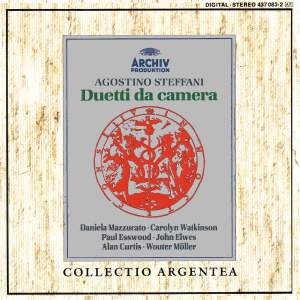
 |
|
1 CD -
437 083-2 - (c) 1986
|
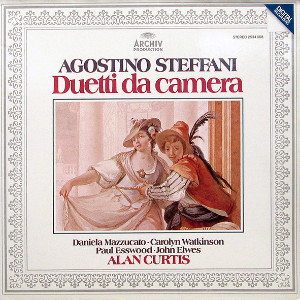 |
| 1 LP -
2534 008 - (p) 1982 |
|
| AGOSTINO
STEFFANI - Duetti da camera |
|
|
|
|
|
Agostino
Steffani (1654-1728)
|
|
|
| 1. Tu
m'aspettasti al mare |
7'
47" |
|
| 2. M'hai da
piangere un dì |
5'
48" |
|
| 3. Io voglio
provar |
6'
05" |
|
| 4. Placidissime
catene |
7'
17" |
|
| 5. Già tu parti |
4'
35" |
|
| 6. E
perchè non m'uccidete |
9'
15" |
|
| 7. No, no, no,
non voglio se devo amare |
4'
49" |
|
| 8. Libertà!
Libertà! |
9'
14" |
|
|
|
|
Daniela
Mazzuccato, Soprano
(1,3,6,8)
|
|
Carolyn
Watkinson, Mezzo-soprano
(2,4,5,8)
|
|
Paul
Esswood, Countertenor
(2,4,5,7)
|
|
John
Elwes, Tenor
(1,3,6,7)
|
|
Wouter Möller, violoncello
|
|
Alan Curtis,
Directed from the harpsichord
|
|
|
|
|
|
Luogo
e data di registrazione |
|
Studio
Lankwitz, Berlin (Germania) -
settembre 1981 |
|
|
Registrazione:
live / studio |
|
studio |
|
|
Producer /
Engineer |
|
Andreas
Holschneider / Heinz Wildhagen |
|
|
Prima Edizione
LP |
|
Archiv
- 2534 008 - (1 lp) - durata 54'
50" - (p) 1982 - Digitale |
|
|
Edizione
"Collectio" CD |
|
Archiv
- 437 083-2 - (1 cd) - durata 54'
50" - (c) 1986 - DDD |
|
|
Note |
|
Recording
made during the BERLINER
FESTWOCHEN 1981. |
|
|
|
|
STEFFANI:
CHAMBER DUETS
The
Italian style of duet now
lacks much of the good
qualities of piety and clarity
mentioned abone,
because
of
its fugal artificial and
interwoven nature.
However, these duets
demand a real man and are
a special delight to
musically-educated ears,
in the chamber
as well as in the church
(and formerly, in
Steffani's time,
also in the theatre),
provided that accomplished
and reliable
singers can be
found
for them; of these we now
have fewer than of such
works themselves. In this
kind of duet the aforesaid
Steffani incomparably
surpassed all other
composers known to me and
deserves to be
taken as a model to this
day; for
such things do not easily
grow old.
Thus wrote Mattheson in Der
vollkommene Capellmeister
in 1739. His opinion
reflects that of his
contemporaries and has been
echoed by every later writer
on the subject. In the 18th
century Steffani’s chamber
duets for two voices and
continuo circulated
throughout Europe in
countless manuscript copies
and were performed in public
and in private, on stage and
at court. Like the trio
sonatas of Corelli (their
instrumental counterparts),
they played a leading role
in the formation and
dissemination of the late
Baroque Italian style and
made a profound impression
on all who knew them. They
influenced such composers as
Keiser, Bononcini, Handel
and Telemann and were
praised by Hawkins, Burney
and Padre Martini. They were
first examined in ‘recent’
times by Friedrich
Chrysander in preparation
for his study of Handel.
Steffani was clearly one of
the foremost Italian
composers of his time. Born
at Castelfranco (Veneto) in
1654, he was educated first
at Padua, then at Munich,
where he was taken at the
age of 13 by the Elector
Ferdinand Maria. After
several years of organ and
composition lessons with the
court organist, Johann
Kaspar Kerll, he went to
Rome in 1672 for further
instruction in composition
from Ercole Bernabei,
director of music at the
Cappella Giulia. His studies
were crowned by the
publication of his Psalmodia
vespertina in 1674,
after which he returned to
Munich and became court
organist and (in 1681)
Director of Chamber Music -
in which capacity he
composed motets and operas,
as well as chamber duets. In
1688 he moved to Hanover as
‘Kapellmeister’ of Duke
Ernst August’s new Italian
opera, for which he composed
at least six three-act works
in as many years. At the
same time, however, he
became increasingly involved
in diplomatic activities. By
1696 he was Hanoverian
‘envoy extraordinary’ to the
Bavarian court at Brussels,
and for Carnival that year
he was replaced as
‘Kapellmeistef by Pietro
Torri, chapelmaster of the
same court. He did compose a
little more music before his
death at Frankfurt in 1728,
but the remainder of his
life was devoted largely to
political and ecclesiastical
affairs in northern Germany,
where he rose to high office.
Steffani wrote over 80
duets. Few of them can be
precisely dated, and most of
these are relatively late
works. Five can be shown by
reference to letters to have
been composed at Brussels in
1698-1700 for Sophie
Charlotte, the Hanoverian
princess who had become
Electress of Brandenburg.
Most of the others were
evidently written by the
autumn of 1702, when he
began to revise them and
prepare a new complete
collection; but at least one
duet (possibly two or three)
was composed some ten years
later.
The contrapuntal nature
mentioned by Mattheson is
particularly apparent in the
later duets, which are
represented on this record
by Placidissime
catene
(Brussels, 1699) and by M'hai
da piangere un dì
and E perchè non m’uccidete
- both of which are
revisions of earlier
settings. Such duets display
an effortless mastery of
imitative counterpoint
(using real and tonal
answers, at various
pitches), double
(invertible) counterpoint,
false entries on the ‘head’
of the subject, and strettos
- which often involve a
series of entries at
ever-decreasing intervals.
They lack the modulatory or
sequential episodes of late
Baroque instrumental fugues,
perhaps because it is
difhcult to split a vocal
subject (a setting of words)
into a number of separate
motives; but a subject
occasionally returns after
lengthy absence, like a
middle or final
entry, with astonishing
effect.
There is much else to
admire, apart from fugal
counterpoint. The duets also
employ homophonic and
antiphonal textures, and
passages dominated by
pedals. The essential point,
however, is that all
available textures are
flexibly deployed so as to
reinforce the structure and
meaning of the words in the
most telling possible
manner. Steffani’s
sensitivity to the texts is
evident in every aspect of
his style, but it is
probably most apparent in
his predilection for
suspensions, in the bass as
well as in the voices, and
in his control of harmonic
rhythm. The kinds of
suspensions he uses, the
speed with which they follow
one another and the period
for which he sometimes dares
to hold them are all
remarkable, as is his
willingness occasionally to
halt the harmonic motion
altogether in order to focus
attention on the sheer sound
of the voices and continuo
(cf. Libertà!
Libertà! and
Già
tu parti). He clearly
possessed a wonderfully
sensitive ear - and the
intelligence to use for
expressive purposes the
effects that he conceived.
Only one of his duets is
known to date from his
Munich years, but it seems
likely that he composed them
from the start of his
career. Tu m'aspettasti
al mare is based on a
poem set as a solo cantata
by Cesti, who died in
1669, while No, no,
no, non voglio se devo
amare draws on the
words and music of a duet
by Cossoni that was
published between 1671 and
1679. Steffani may have
come across both works in
Italy in the 1670s. His
earlier duets are
characterized by somewhat
looser contrapuntal
textures and a
correspondingly greater
emphasis on lyrical melody
and movements for solo
voice (cf. Io voglio
provar). They
frequently employ the
triple and compound metres
of the mid-seicento
(17th-century) aria and
the intricate formal
schemes of the
contemporary solo cantata.
Taken as a whole,
Steffani’s duets may be
said to represent a cross
between the solo cantata
and the trio sonata. The
present recording
illustrates the formal as
well as the stylistic
range of his output in the
genre and affords an
insight into the
development of Italian
music in general during a
period when it came to
dominate much of Europe.
Colin
Timms
|
|